
🎯 Key Takeaways
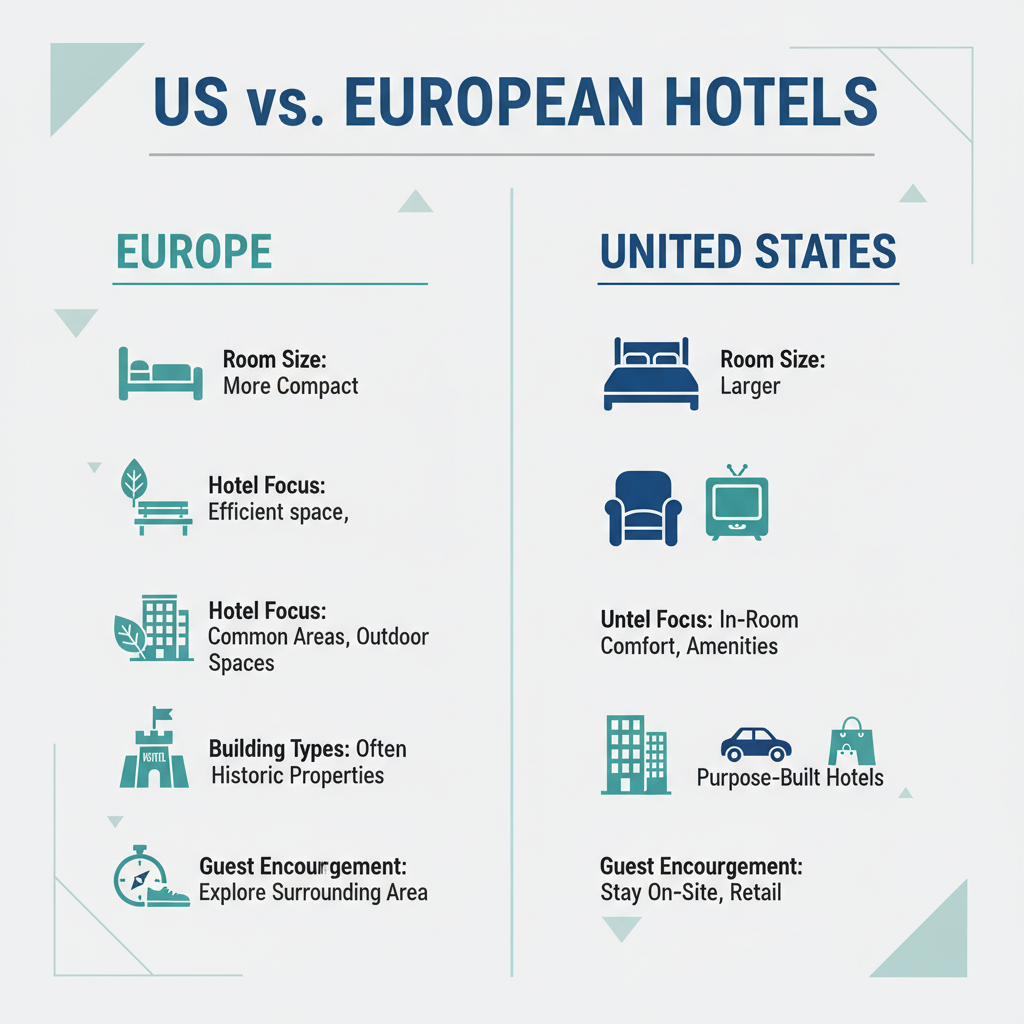
- Expect smaller hotel rooms in Europe compared to American standards.
- Embrace the efficient use of space in European hotel designs.
- Utilize public spaces and local areas instead of staying in your room.
- Prepare for a cultural shift in hotel experiences before traveling.
- Consider upgrading to a higher room category for more comfort.
⚡ TL;DR
American travelers should prepare for smaller hotel rooms in Europe, as space is at a premium in many cities. European hotels often prioritize efficient use of space and encourage exploration of local culture rather than time spent in rooms. Embracing these differences can enhance the travel experience, making it uniquely enjoyable.
Prior to embarking on your much-anticipated trip to Europe, we assume you have considered various aspects of your journey. However, have you ever taken into account the contrasts between American and European hotels? If not, we are here to familiarize you with all the cultural distinctions you will experience during your upcoming hotel stay in Europe.
If you are excited about the idea of traveling to Europe and can only think about the flaky croissants you will enjoy in Paris and the delightful cappuccinos you will savor in Rome, you may be disappointed when you enter your hotel room after checking in on your first day in Europe. Why? It is because hotel rooms in Europe are quite different from what you are accustomed to in your home country.
This is definitely not something that should make you reconsider. It’s all about embracing the European way of life. Nevertheless, it’s important to be ready. And who can get you ready better than JayWay? So, without delay, here’s our list of the major distinctions between American and European hotels that you should take into account before your next European vacation.

12 Eye-Opening Differences: American vs. European Hotels
1. The size of hotel rooms in Europe is more compact.
Space is a valuable asset in Europe, especially in the cities and capitals as opposed to rural areas. Europeans are accustomed to living in smaller homes and staying in compact hotel rooms, a stark contrast to the expectations of Americans who may be surprised by the room sizes when visiting Europe for the first time.
Whether your accommodation in Europe is situated in historic buildings or not, hotel rooms in Europe tend to be considerably smaller than those in the US, even within the same category, regardless of whether it’s a 3- or 5-star hotel and irrespective of the room rate. Surprisingly, it’s not uncommon for familiar hotel chains from North America to offer small rooms on the other side of the Atlantic.
European hotels typically prioritize efficient use of space and may also offer other amenities such as common areas or outdoor spaces for guests to enjoy, rather than larger individual rooms. It’s also worth noting that many European cities have more historical properties that have been converted into hotels, which can result in smaller room sizes compared to newer hotel properties in the US.
Additionally, due to the smaller room sizes, European hotels often emphasize the use of public spaces and encourage guests to explore the surrounding area, rather than spending a lot of time in their rooms. This can be a unique and enjoyable aspect of staying in a European hotel, as it allows guests to experience the local culture and atmosphere of the destination.
Overall, while European hotel rooms may be smaller than their US counterparts, the focus on efficient design and making the most of available space can still provide a comfortable and enjoyable experience for travelers. And of course, upgrading to a higher room category is always an option for those who prioritize more space during their stay.
2. The beds are also smaller
As European hotel rooms tend to be smaller than their American counterparts, it’s inevitable that the beds will also be smaller. In contrast to American hotels, which often have two double beds in a room, European hotels typically offer either one large bed or two single beds pushed together. If you request a third bed, it will likely be a rollaway bed or pull-out couch for an additional charge.
However, high-quality hotels in Europe, including smaller boutique hotels, B&Bs, and guesthouses, make an effort to ensure guests have a comfortable stay by providing rooms with top-notch mattresses and bed linens.
Additionally, many European hotels also offer room configurations with bunk beds or loft beds to accommodate families or groups traveling together. While the size of the bed may be smaller, the level of comfort is not compromised, as European hotels prioritize providing a good night’s sleep for their guests.
Furthermore, European hotels often have amenities such as luxurious duvets, high thread count sheets, and premium pillows to enhance the sleeping experience. Some hotels even offer a pillow menu, allowing guests to choose from a selection of different pillows to suit their preferences.
Overall, while the beds in European hotels may be smaller, the focus on quality and comfort ensures that guests can still enjoy a restful and rejuvenating night’s sleep during their stay.
3. You’ve got it: bathrooms are also smaller.
Due to limited space, hotel bathrooms in Europe tend to be compact. You may be surprised to find that you can easily touch all the walls while standing in the bathroom without stretching your arms too far. It’s likely that your room will have a walk-in shower instead of a bathtub, unless you’re staying in a 5-star luxury hotel.
Additionally, many European bathrooms will have a toilet with a separate small sink, as well as a main sink in the bedroom area. This setup allows for more efficient use of space in the bathroom.
Overall, while European hotel bathrooms may be small, they are designed to be functional and practical. And with the beautiful sights and attractions just outside your hotel, you’ll likely spend more time exploring than lounging in the bathroom anyway!
4. Bidets can be found everywhere in Southern Europe.
In Europe’s warmer countries, despite the limited space in most hotel bathrooms, they all tend to have one thing in common: a bidet. If you’re unfamiliar with bidets, they are a type of low sink used for hygiene after using the toilet. While not all Europeans use bidets, it appears that hotels in Europe are unwilling to do away with them.
So why do bidets remain popular in European hotels? There are a few reasons for this.
First, bidets are seen as a more hygienic option than using just toilet paper alone. They can help to clean more thoroughly and reduce the risk of irritation or infection. This is especially important in warmer climates, where people may feel the need to freshen up more frequently.
Second, bidets are considered a cultural norm in many European countries. They have been a fixture in European bathrooms for centuries, and many people simply prefer to have one available when they travel.
Finally, some argue that bidets are more environmentally friendly than using toilet paper, as they reduce the amount of paper waste that ends up in landfills. This is in line with the growing global trend towards sustainability in travel and hospitality.
Overall, it seems that European hotels continue to include bidets in their bathrooms because they are seen as a practical, cultural, and environmentally friendly option. While they may take up some space, their benefits are valued by many travelers, making them a staple in European hotel bathrooms.
5. European hotels do not provide washcloths.
While bidets are common all across Europe, the presence of washcloths is not as widespread. While it is standard to find a washcloth alongside fresh towels in American hotels, European hotels rarely offer them. If you rely on washcloths, it’s wise to pack your own when traveling to Europe.
6. European showers differ from their US counterpa
In conclusion, the disparities between American and European hotels with regards to room bathrooms are evident. It is likely that you will have a walk-in shower rather than a bathtub in your European hotel room. There are a few important points to consider.
Firstly, handheld shower heads are common in European hotels. Additionally, glass doors, rather than shower curtains, are often found in European bathrooms. These glass doors may not always close completely, making it a challenge to shower without causing a mess in the bathroom. However, the designers have taken this into account and ensured that the water will drain away properly.
Almost invisible shower glass walls and doors are a common feature in European hotels.
7. Floor numbers are different
A distinction between American and European hotels that may not have occurred to you is how they number their floors. In the US, the hotel lobby is on Level 1 and the rooms above it are on Level 2 (the second floor).
But in Europe, Level 1 is the first floor above the ground level. So, a European hotel lobby is typically on Level 0 and the rooms above it are on the hotel’s first floor. If there is a level below the lobby, it is labeled as Floor -1.

8. Elevators are tiny or non-existent
When it comes to floors and levels, let’s move on to our next topic: elevators. In Europe, elevators are typically narrow and compact. At times, they may struggle to accommodate both you and your luggage. This is especially true for hotels located in city centers or housed in historic buildings constructed before elevators became common.
Finding room and an effective way to install elevators in old buildings is a significant challenge. Not to mention the difficulty of making these elevators as spacious as the ones you’re likely accustomed to in the US. Therefore, anticipate very small spaces in European elevators and, if you suffer from claustrophobia, you might prefer taking the stairs instead.
Which option would you select? Regardless, having a small elevator is preferable to not having one at all. It is also possible that this could occur. If you are staying in a hotel located in a historically significant building, it may not be possible to install an elevator due to regulations preserving the building’s character. Hence, when making reservations for your stay in Europe, always make sure to confirm if there is an elevator, particularly if you have mobility concerns.
9. Power outlets that are not compatible with each other
Before traveling to Europe, it is essential to understand the differences in electrical power between European countries and the United States. European outlets have a higher voltage (220v) compared to American outlets (110v), and the socket designs are also different, making it necessary to purchase converters for electronic devices.
With that being said, make sure to only bring essential items like your phone, tablet, or laptop charger (make sure it can switch between 110v and 220v). Avoid packing your curling iron or hairdryer, as using a converter may cause damage to them in Europe. Most hotels in Europe provide hairdryers, so there’s no need to bring your own.
When it comes to European outlets, not all hotel rooms have a socket near the bed, which can be inconvenient if you’re used to charging your phone while you sleep. A helpful travel tip is to charge your phone away from your bed for a better night’s sleep, especially when adjusting to a new time zone.
10. Do not be worried by the absence of alarm clocks.
While it is customary for American hotels to have an alarm clock by the bed, this is not the norm in Europe. Most of the time, European hotel rooms do not have a clock at all. Before getting frustrated, consider this: not keeping track of time is a key aspect of a true vacation, right?
However, there may be occasions when you need to set an alarm for an early morning excursion or flight. In such situations, you can rely on your smartphone’s alarm clock or request a wake-up call from the hotel front desk.
11. Some locations could seem antiquated.
European hotels are known for their exceptional cleanliness, but their style choices can sometimes be lacking. It’s not uncommon to find a hotel room in Europe that may seem a bit outdated. A more refined way to describe these hotel rooms would be to call them old-fashioned.
Nevertheless, an increasing number of hotels are adopting more minimalist and modern designs when they refurbish their rooms, so nostalgic rooms may soon become a thing of the past.
12. Air conditioning in Europe does not reach the same low temperatures as it does in the US.
Europeans tend to steer clear of using the air conditioning, unlike their American counterparts. If they do use it, they will opt for a more moderate temperature setting. This is largely due to the fact that most Europeans, especially those in Central and Northern Europe, did not grow up with air conditioning. It also reflects their awareness of the environmental impact of using air conditioning.
This complex relationship with air conditioning is evident in hotels throughout Europe. In some cases, hotel rooms in colder regions like the Baltic states or the Swiss mountains may not have air conditioning at all. It’s important to note that the air conditioning in your room may not be able to reach the temperatures you are accustomed to, due to local environmental regulations.
Final Thoughts: Unlocking Hotel Insights
In summary, understanding the differences between American and European hotels is crucial for a successful trip. From compact room sizes to a greater emphasis on communal spaces, these distinctions offer a unique opportunity to immerse yourself in the local culture. Embracing this new experience can enhance your travel adventure, making it all the more memorable. So, as you plan your European getaway, remember to keep an open mind and appreciate the charm of European accommodations. Let JayWay assist you in navigating these differences and make your journey unforgettable—book your trip today and step into a world of new experiences!
Frequently Asked Questions
What are the typical check-in and check-out times in European hotels?
Check-in times in European hotels generally start around 2 PM, while check-out is often required by 11 AM. However, it’s always a good idea to confirm with your specific hotel, as some may offer flexible options or allow you to store your luggage if you arrive early or need to leave later.
Are there any additional fees I should expect when booking a hotel in Europe?
Yes, many European hotels may charge additional fees such as city taxes or resort fees that are not included in the initial booking price. Be sure to read the hotel’s policy and inquire about any potential extra costs to avoid surprises at check-out.
How can I find hotels that cater specifically to American travelers?
Look for hotel chains that have properties in both the US and Europe, as they often maintain similar standards and amenities. Additionally, reading reviews from fellow American travelers on platforms such as TripAdvisor can provide insight into which hotels offer a more familiar experience.
What should I know about breakfast options in European hotels?
Breakfast offerings in European hotels can vary significantly, with some hotels providing a complimentary continental breakfast while others charge extra for a full meal. If breakfast is important to you, check the hotel’s amenities ahead of time and consider exploring local cafés for a more authentic experience.
Are there differences in hotel staff tipping practices between Europe and America?
Tipping practices in Europe can differ, as service charges are often included in your bill. While rounding up the bill or leaving a small tip for exceptional service is appreciated, it’s not as customary or expected as in the United States.
What amenities should I expect in a typical European hotel room?
European hotel rooms may include basic amenities such as free Wi-Fi, a television, and a small bathroom, but luxury items like air conditioning or coffee makers may not always be standard. It’s helpful to check the hotel’s website or contact them directly to confirm which amenities are provided to ensure a comfortable stay.