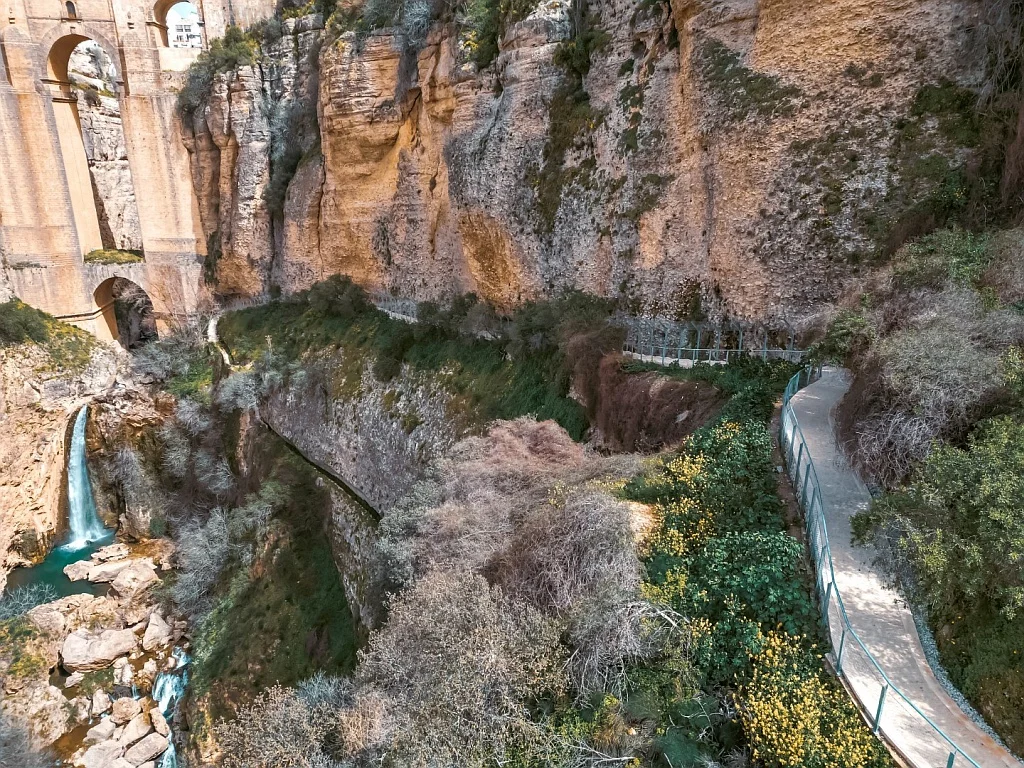
For 250 years, the only way to see the Puente Nuevo was from above — from the viewpoints in Ronda’s old town, looking down into a gorge most visitors never actually enter. Since April 2024, that’s changed. The Desfiladero del Tajo is a suspended walkway that descends into the gorge itself and takes you to the base of the bridge — underneath the arches, at river level, looking straight up at 98 metres of stone that most people only ever photograph from the top. This is everything we know about it, and how we’re building it into a new Ronda experience.
🎯 Key Takeaways
- What it is: A 250-metre suspended footbridge inside Ronda’s gorge, reaching the base of the Puente Nuevo — opened April 2024.
- Where it starts: Casa Manolillo, a restored building reached via Plaza del Campillo and the Camino de La Albacara — now the entrance and interpretation centre.
- Ticket price: €5 per person — book online, maximum 4 tickets per transaction.
- Not the Caminito del Rey. Different gorge, different town, different structure — this one is inside Ronda itself.
- Restricted access: Maximum 30 people per hour — children under 8 not permitted.
- Phase 2 update (July 2026): construction is complete but the opening is delayed by a legal dispute — no confirmed date yet. Full route price will rise to €12 once both phases open.
- Coming soon from Costa Excursions: a combined tour pairing a short Ronda highlights walk with the Desfiladero del Tajo descent.
⚡ TL;DR
The Desfiladero del Tajo is a suspended walkway that descends into Ronda’s gorge to the base of the Puente Nuevo — a view of the bridge that simply didn’t exist for tourists before Phase 1 opened in April 2024. €5 per ticket, book ahead, 30 people per hour maximum, not suitable for children under 8. Phase 2 — a further 500 metres extending the route to the Arab Baths — is physically complete as of mid-2026 but still awaiting an official opening date due to a pending legal matter; once both phases are open, the combined ticket price rises to €12. It’s a short walk rather than a full day activity, which makes it the perfect addition to a Ronda day trip. We’re building a tour that combines Ronda’s essential sights with a guided descent into the gorge — coming soon.
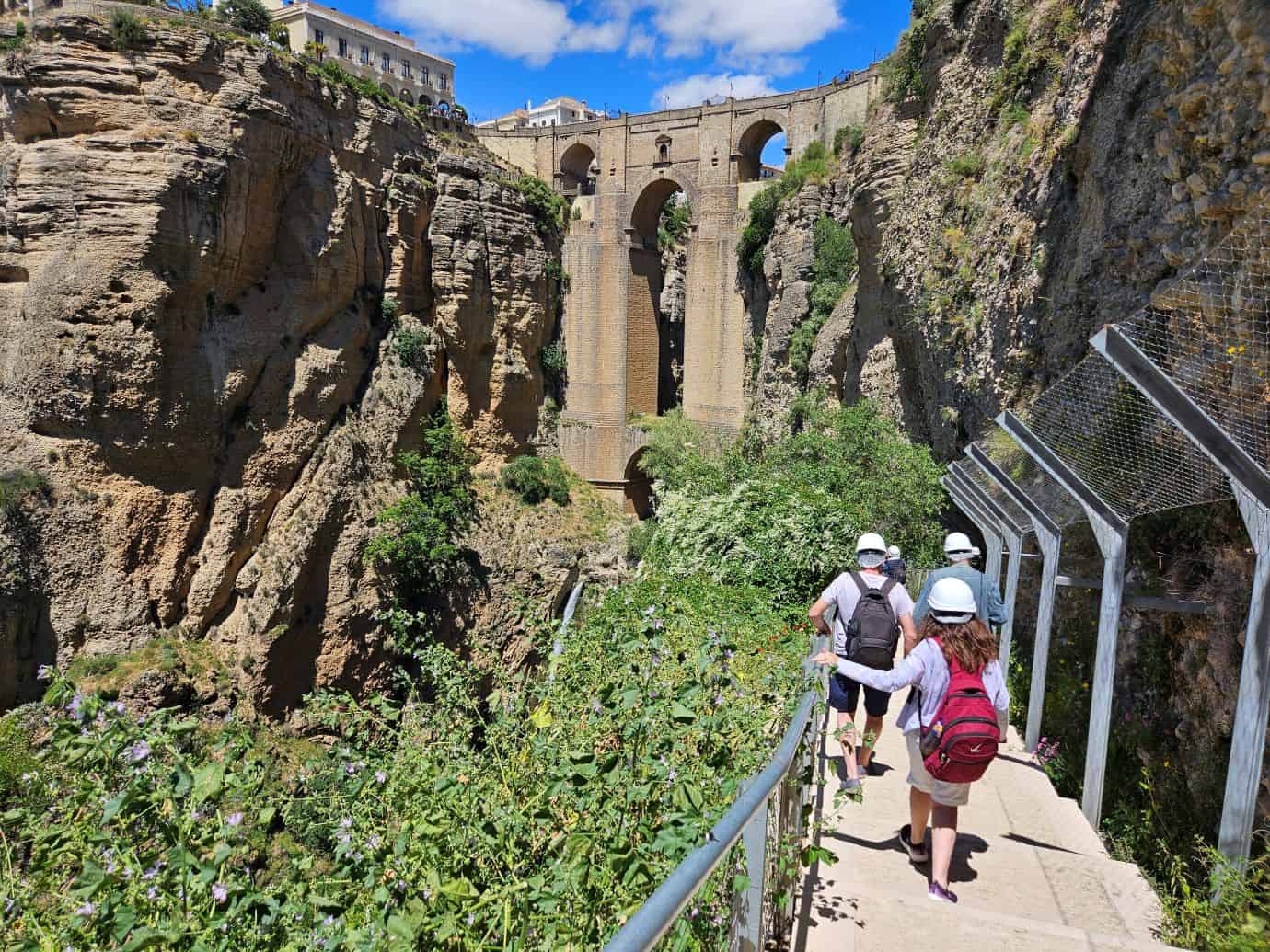
Ronda’s defining image has always been the view from above — the Puente Nuevo spanning the gorge, photographed from the Mirador de Aldehuela or the Jardines de Cuenca, the 98-metre drop visible but never actually entered. Millions of photographs of this bridge exist. Almost none of them are taken from where the Desfiladero del Tajo now takes you: the base of the gorge, looking up.
The project opened its first phase to the public in April 2024, after the Ronda town council presented plans to give visitors physical access to the gorge floor for the first time in a managed, safe way. It’s modelled — deliberately — on the Caminito del Rey, the walkway near Málaga that turned a maintenance path into one of the most visited attractions in Andalusia. The Desfiladero del Tajo does something similar, but entirely within Ronda itself, and at a fraction of the scale and time commitment.
Table of Contents
What the Desfiladero del Tajo Actually Is
The Tajo de Ronda is the limestone and sandstone gorge that the Río Guadalevín has carved over roughly 65 million years — more than 100 metres deep and around 70 metres wide at its widest point. It’s officially a Monumento Natural de Andalucía and one of the more significant geological formations in southern Spain. Since the mid-18th century, the Puente Nuevo has crossed it, connecting Ronda’s old Moorish town to the newer part of the city.
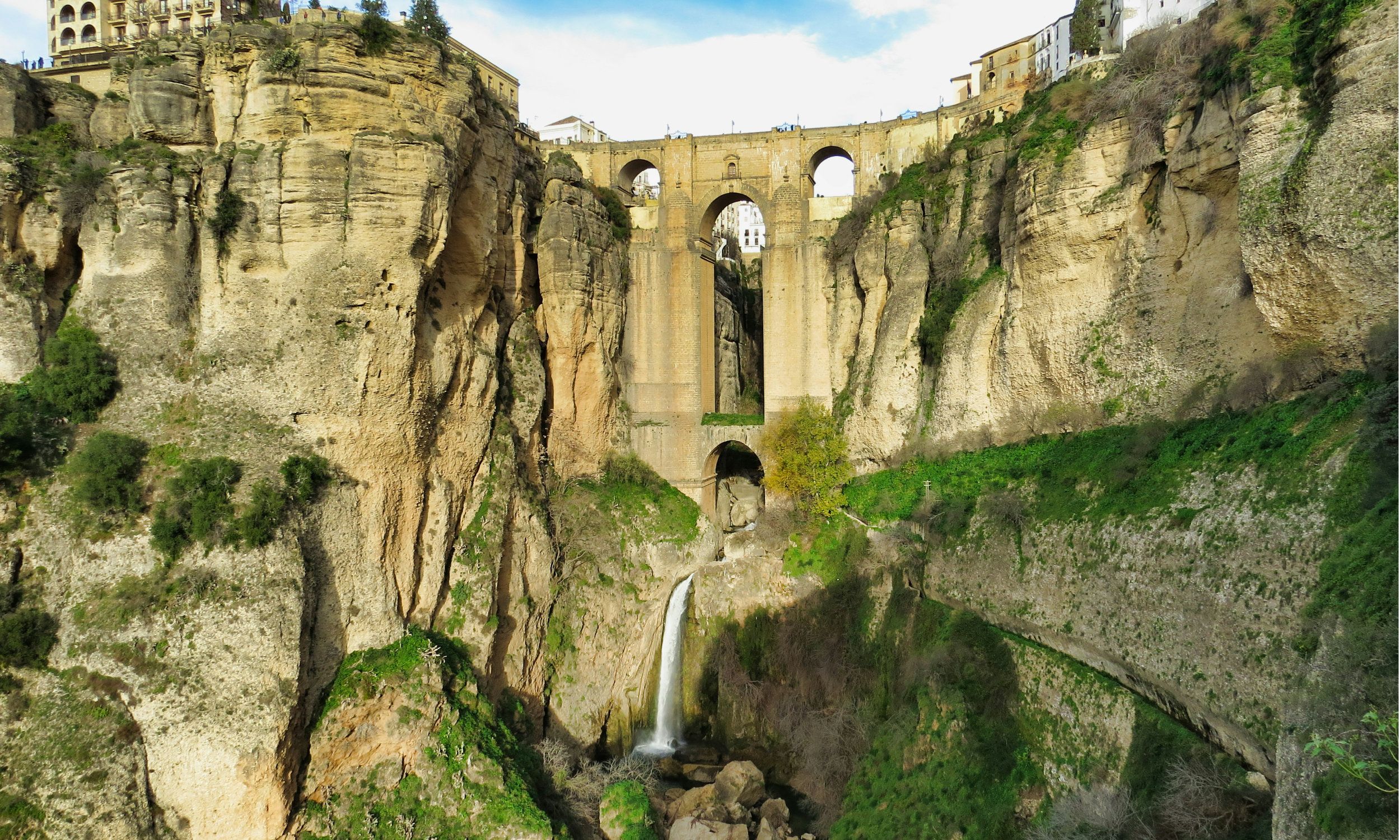
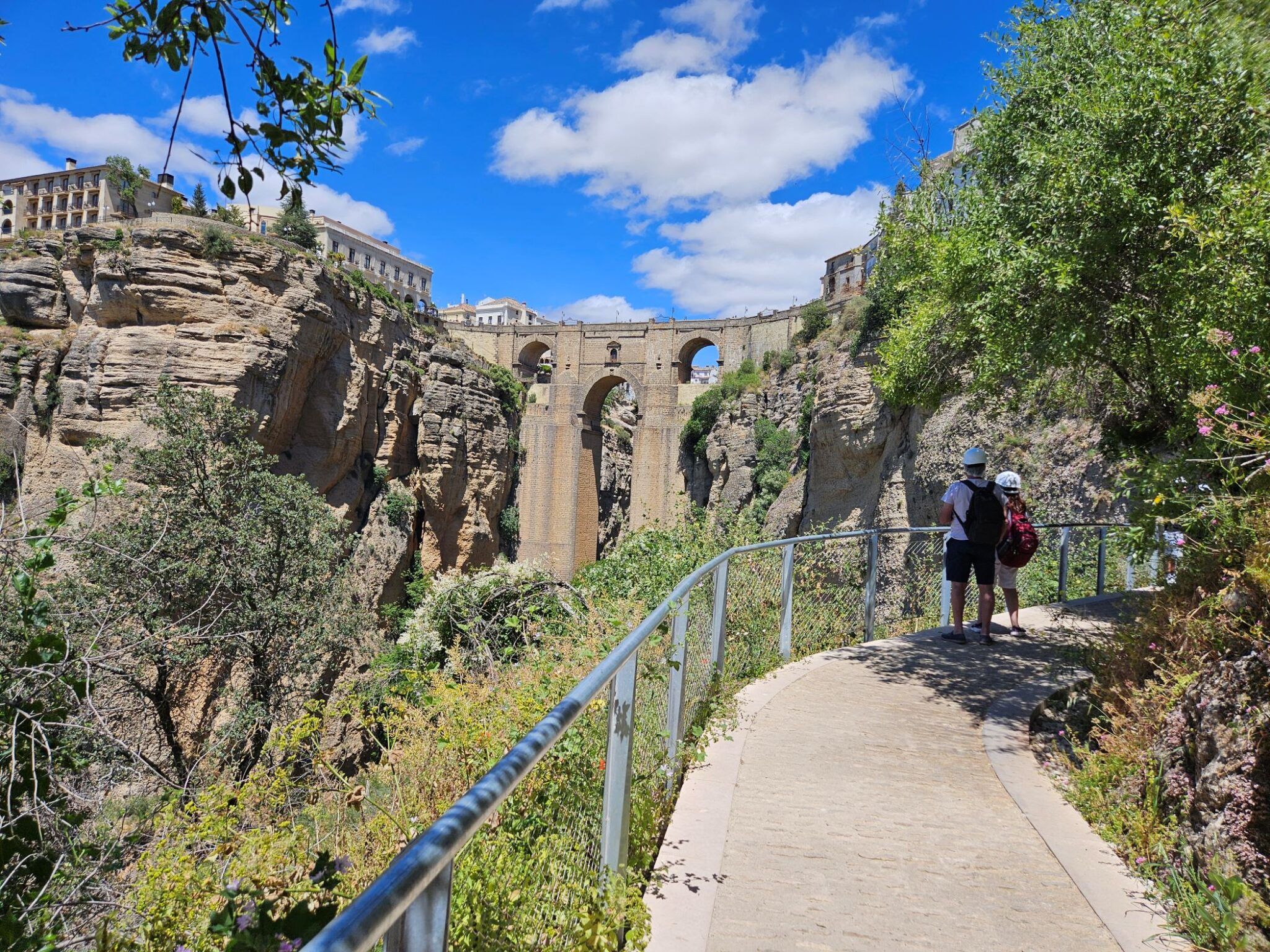
The Desfiladero del Tajo walkway is a suspended footbridge that descends the western wall of the gorge (la Hoya) and follows the river to the exact base of the Puente Nuevo — underneath its foundations. The current first phase is approximately 250 metres of walkway, clinging to the rock roughly 3 metres above the river, engineered in the same style as the Caminito del Rey: composite decking, secure railings, built to handle regular visitor traffic without disturbing the geology or ecology of the gorge.
At the base of the bridge, the path passes through a small original tunnel cut beneath the Puente Nuevo — built in the 18th century to allow the town’s irrigation channels (acequias) to continue flowing under the new bridge. Walking through it now, as a visitor, means passing through 260-year-old engineering built for an entirely different purpose.
What You See
The walkway gives views that were previously inaccessible to the public:
- The Puente Nuevo from directly below — the full 98-metre elevation, seen from the foundations rather than the top. This is the image that doesn’t exist anywhere in the standard Ronda photo collection.
- The Guadalevín river and its pools — waterfalls and natural pools at the base of the gorge, fed by the river that carved the whole formation.
- All three of Ronda’s bridges — the Puente Nuevo (18th century), the Puente Viejo (16th century), and the Puente Árabe / Puente Romano (the oldest, of Moorish or possibly Roman origin) — visible together from a single vantage point that doesn’t exist from street level.
- The gorge walls themselves — vertical limestone and sandstone faces up close, with the geological banding visible at a scale you can’t appreciate from the viewpoints above.
Practical Information
Where it starts
The entrance is at Casa Manolillo, a restored historic building that now functions as an interpretation centre and access control point. To find it: from Plaza del Campillo in the old town, follow the recently restored Camino de La Albacara as it descends toward the gorge — Casa Manolillo marks the entrance, at the top of the walkway.
Tickets
- Price: €5 per person
- Booking: Online in advance, at the official site — maximum 4 tickets per transaction
- Capacity: Limited to 30 people per hour to protect the experience and the site
- Ronda residents: Free entry with ID, subject to availability
- Age restriction: Children under 8 are not permitted — the same restriction as the Caminito del Rey, for similar safety reasons
Opening hours
| Season | Hours |
|---|---|
| Winter | 9:00 AM – 5:00 PM, daily |
| Spring / Autumn | 10:00 AM–2:00 PM and 4:00 PM–8:00 PM, daily |
| Summer | 10:00 AM–2:00 PM and 6:00 PM–9:00 PM, daily |
The split opening hours in spring, summer, and autumn exist to avoid the hottest hours of the day — sensible given the walkway is largely exposed to direct sun for parts of its length.
How long does it take
30–45 minutes for the walkway itself at a relaxed pace, including time to stop at the viewpoints along the route and inside the tunnel beneath the bridge. This is a short, focused experience — not a half-day hike. That’s precisely what makes it easy to combine with other things in Ronda on the same visit.
What to wear
Comfortable flat shoes with grip — some sections are uneven and the surface can be affected by moisture near the river. Sun protection for the exposed sections in summer. A light layer in winter, since the gorge floor is noticeably cooler and shadier than the town above.
Is This the Same as the Caminito del Rey?
No — and this is worth clarifying because the names and the visual style are similar enough to cause genuine confusion.
| Desfiladero del Tajo | Caminito del Rey | |
|---|---|---|
| Location | Inside Ronda itself | Los Gaitanes Gorge, near Álora/Ardales, 60 km from Málaga |
| Length | ~250 m now (Phase 1) · ~700–1,000 m once Phase 2 opens | 7.7 km total |
| Duration | 30–45 minutes | 3–4 hours |
| Price | €5 | €10 |
| Opened | April 2024 | 2015 (rebuilt) |
| Height above ground | ~3 metres above the river | Up to 100 metres above the river |
| Best combined with | A short Ronda city visit | A dedicated half-day trip |
Both are inspired by the same idea — give visitors physical access to a gorge that was previously only viewed from above — but they are different attractions in different towns, at completely different scales. The Desfiladero del Tajo is much shorter, much closer to the ground, and designed to complement a Ronda visit rather than be a destination in its own right. Some visitors do both on the same trip to the region, since they’re only about an hour apart by car.
What’s Next: Phase 2 Is Built — Opening Date Not Yet Confirmed
Update, July 2026: Phase 2 construction is now physically complete. The new 500-metre section — designed by the same architect behind the Caminito del Rey — extends the walkway from the base of the Puente Nuevo past the Puente Viejo to the Ermita de San Miguel and the historic Arab Baths, in the Padre Jesús neighbourhood. Once both phases are open together, the full Camino del Desfiladero del Tajo will run to nearly 700–1,000 metres through the gorge — connecting areas of Ronda that have been inaccessible from below for centuries.
The project cost over €1.3 million, half funded by the Diputación de Málaga. Test visits have already been run for Ronda residents, with strong feedback. Ronda’s tourism board estimates the completed walkway could draw around 250,000 visitors a year, up from roughly 160,000 for Phase 1 alone.
What’s holding up the official opening: a legal dispute over a section of platform near the mouth of the Casa del Rey Moro’s water mine, on land classified as Dominio Público Hidráulico (public hydraulic land). The council and the Casa del Rey Moro’s ownership reached a provisional agreement in June 2026 to share the platform while the courts decide long-term use — but a firm public opening date for Phase 2 has not yet been announced as of this writing.
Pricing once Phase 2 opens: the full combined route (both phases) is expected to cost €12 per person, up from the current €5 for Phase 1 alone. Ronda residents will continue to have free access.
We’re monitoring this closely and will update this guide the moment an official opening date is confirmed.
Coming Soon: Our Ronda + Desfiladero del Tajo Tour
We’re building a new private tour that combines a shortened version of our classic Ronda day — the Puente Nuevo viewpoints, the old town, the essential history — with a guided descent through the Desfiladero del Tajo. Rather than trying to fit everything Ronda offers into one day, this tour is designed for guests who specifically want the gorge experience: the view from above at the main viewpoints, and then the view from below, at the base of the bridge, in the same visit.
It’s a shorter, more focused alternative to our full Ronda day trip — better suited to guests with less time, cruise passengers with a tighter port window, or anyone who wants Ronda’s single most photogenic experience — the bridge, seen both ways — without committing to a full 8-hour day.
Want to be first to know when this tour launches?
We’re finalising the itinerary and timings now. WhatsApp us at +34 651 026 027 to register your interest — we’ll let you know as soon as booking opens, and can also arrange the Desfiladero del Tajo as an add-on to our existing full-day private Ronda tour in the meantime.
Frequently Asked Questions
What is the Desfiladero del Tajo in Ronda?
The Desfiladero del Tajo is a suspended footbridge, opened in April 2024, that descends into Ronda’s gorge and reaches the base of the Puente Nuevo bridge. It gives visitors a view of the bridge from below for the first time — previously only viewable from the town’s viewpoints above. The first phase is approximately 250 metres long, takes 30–45 minutes to walk, and costs €5 per person.
Is the Desfiladero del Tajo the same as the Caminito del Rey?
No. They are separate attractions in different locations, though the Desfiladero del Tajo was deliberately modelled on the Caminito del Rey’s design. The Caminito del Rey is a 7.7 km trail near Álora and Ardales, 60 km from Málaga, taking 3–4 hours and reaching up to 100 metres above the river. The Desfiladero del Tajo is inside Ronda itself, only 250 metres long, taking 30–45 minutes, and staying close to river level.
How much does the Desfiladero del Tajo cost?
€5 per person. Tickets must be booked online in advance, with a maximum of 4 tickets per transaction. Ronda residents can enter free with ID, subject to availability. Access is limited to 30 people per hour.
Where does the Desfiladero del Tajo start?
At Casa Manolillo, a restored historic building functioning as the entrance and interpretation centre. It’s reached from Plaza del Campillo in Ronda’s old town via the Camino de La Albacara, which descends toward the gorge.
Can children do the Desfiladero del Tajo?
Children aged 8 and over are permitted. Children under 8 are not allowed, for the same safety reasons that apply at the Caminito del Rey — the walkway involves exposed sections above the river and the operator restricts access accordingly.
How long does the Desfiladero del Tajo take?
30–45 minutes at a relaxed pace, including stops at the viewpoints and the tunnel beneath the Puente Nuevo. It’s a short, focused walk rather than a half-day activity, which makes it easy to combine with the rest of a Ronda visit on the same day.
Is Phase 2 of the Desfiladero del Tajo open yet?
Not officially, as of July 2026. Construction is physically complete — a 500-metre extension from the base of the Puente Nuevo to the Ermita de San Miguel and the Arab Baths, designed by the Caminito del Rey’s architect. The opening has been delayed by a legal dispute over a section of platform near the Casa del Rey Moro water mine, on land classified as public hydraulic domain. A provisional agreement was reached in June 2026, but no firm public opening date has been announced. Once open, the combined Phase 1 + Phase 2 route will cost €12 per person.
Can I combine the Desfiladero del Tajo with a Ronda day trip?
Yes — this is exactly what we’re building. A tour combining the essential sights of Ronda (Puente Nuevo viewpoints, old town) with a guided descent into the gorge via the Desfiladero del Tajo. Contact us for details on availability, or book it as an add-on to our existing full-day private Ronda tour in the meantime.
Final Thoughts
Ronda has been photographed from above for 250 years. The Desfiladero del Tajo is the first time visitors have been able to walk to the base of the Puente Nuevo and see it the other way round — at river level, looking up. It’s short, it’s inexpensive, and it pairs naturally with everything else Ronda offers. We’re building a dedicated tour around exactly this combination — WhatsApp us at +34 651 026 027 to register interest, or see our current private Ronda day trip → in the meantime.