

Granada: Complete Visitor Guide from Malaga and Marbella
Granada is 158 km from Málaga — 1 hour 30 by car or 1 hour 20 on the AVE. It has the Alhambra, which is one of the great buildings in Europe.It has the Albaicín, a Moorish quarter that predates […]
Granada is 158 km from Málaga — 1 hour 30 by car or 1 hour 20 on the AVE. It has the Alhambra, which is one of the great buildings in Europe.It has the Albaicín, a Moorish quarter that predates the Alhambra and survived both the Reconquista and 500 years of Spanish urbanisation more or less intact. It has the Sierra Nevada directly behind it — the highest mountains in Spain. And it has free tapas with every drink, a tradition that survives nowhere else in Andalusia at this scale. This is the complete guide to visiting Granada from the Costa del Sol.
🎯 Quick Facts
- Distance from Málaga: 158 km — 1 hour 30 by car, 1 hour 20 by AVE train
- Distance from Marbella: 185 km — approximately 2 hours by car
- Alhambra tickets: €19 adult — book at tickets.alhambra-patronato.es. Sell out 2–3 months ahead in high season.
- Best months: April–June and September–October
- Avoid: July–August inland heat (38°C+) and winter for the Alhambra if you want comfortable conditions
- Private tour available: from €800/group — Alhambra tickets included from our operator allocation
Granada was the last Moorish kingdom in Spain. The Nasrid dynasty held it from 1238 until 1492 — 260 years after the rest of Andalusia had fallen to the Reconquista. In those 260 years, they built the Alhambra. The result is a palace complex that had no equivalent in medieval Europe: 856 columns in the throne room, fountains fed by an aqueduct from the Sierra Nevada, carved plasterwork ceilings so intricate that the mathematical patterns inside them weren’t fully understood by Western scholars until the 20th century. Washington Irving moved in and wrote a book about it in 1829. It’s been the most visited monument in Spain ever since.
Granada is a long day from Málaga — 158 km, 9–10 hours total if you’re going properly. It’s worth it.

Discover the stunning Alhambra Palace in Granada, a top day trip destination from Malaga in 2023, with breathtaking mountain scenery.
🏰 The Alhambra
The Alhambra is a fortified palace complex on a hill above Granada, built between the 13th and 14th centuries. It has three distinct sections:
Nasrid Palaces
The centrepiece — three interconnected royal palaces built by the last Nasrid sultans. The Mexuar (administrative), Comares Palace (ceremonial), and Palace of the Lions (private royal quarters). The Court of the Lions — a marble courtyard with 124 columns and a central fountain supported by 12 carved lions — was built between 1362 and 1391. The Hall of the Ambassadors has a cedar ceiling made of 8,017 individual interlocking pieces representing the seven Islamic heavens. The Hall of the Abencerrajes has a muqarnas ceiling — a stalactite-like geometric vault — that has been the subject of mathematical study for 150 years.
The Nasrid Palaces have timed entry — your ticket specifies a 30-minute window during which you must enter. Miss it and you lose access for the day. This is the most important practical fact about visiting the Alhambra. The rest of the complex (Alcazaba, Generalife) has no timed entry and can be visited any time during opening hours.
Generalife
The summer palace and gardens of the Nasrid rulers, on the hill adjacent to the Alhambra. The Acequia courtyard — a long rectangular pool flanked by flower beds, jets of water, and hedged walkways — is one of the most photographed spaces in Andalusia. Quieter and more meditative than the Nasrid Palaces. Allow 45 minutes.
Alcazaba
The oldest section — a military fortress predating the Nasrid Palaces by several centuries. The Torre de la Vela (watchtower) gives the best panoramic view in Granada: the Albaicín directly opposite, the Generalife and Nasrid Palaces alongside, the Sierra Nevada behind, and the city below. Usually the least crowded section. Allow 30–45 minutes.
Tickets
- General ticket (recommended): €19 adult — covers Nasrid Palaces, Alcazaba, and Generalife
- Generalife + Alcazaba only: €9 — skips the Nasrid Palaces (not recommended unless general is sold out)
- Children under 12: free
- Book at: tickets.alhambra-patronato.es — official site only
- How far ahead: 2–3 months for April–October, 1–2 weeks for November–March
If tickets are sold out on the official site, licensed tour operators have a separate allocation. Our private Granada day tours include Alhambra tickets from our operator allocation — see details below.
🏘️ The Albaicín
The Albaicín is Granada’s old Moorish quarter, on the hill directly opposite the Alhambra across the Darro river valley. It predates the Alhambra — much of it was already built before the Nasrid dynasty began construction on the palace in the 13th century. It’s been a UNESCO World Heritage Site since 1994.
The street layout is a medieval Islamic medina — narrow, winding lanes that don’t follow a grid, dead ends, hidden squares, streets that change name every two blocks. It’s the kind of neighbourhood where getting slightly lost is the point. The main route up from the city centre — Calle Calderería Nueva and the parallel lanes — passes tea houses (teterías), Moroccan spice shops, and a density of North African culture that reflects the neighbourhood’s centuries of Moorish history.
Mirador de San Nicolás
The most photographed viewpoint in Granada — a small square at the top of the Albaicín with the Alhambra directly opposite, the Sierra Nevada as a backdrop, and the city below. The view is genuinely extraordinary, particularly in the late afternoon when the sun hits the red Alhambra walls. Arrive before 5 PM in summer to find space — it gets crowded at sunset. Street musicians play here most evenings.
Mirador de San Cristóbal
Less known than San Nicolás but often better — a viewpoint at the northern edge of the Albaicín with a wider view over the old city, the plain of Granada, and the mountains. Fewer tourists. Worth the extra 10-minute walk from San Nicolás.
Sacromonte
Adjacent to the Albaicín, Sacromonte is the cave quarter — a hillside of whitewashed cave houses that have been inhabited continuously for centuries, originally by the Roma community. It’s known for flamenco zambra — the cave-based flamenco of Granada, different in character from Seville or Cádiz flamenco. Several cave venues run nightly performances; quality varies. If you’re specifically interested in flamenco, Sacromonte is worth an evening.
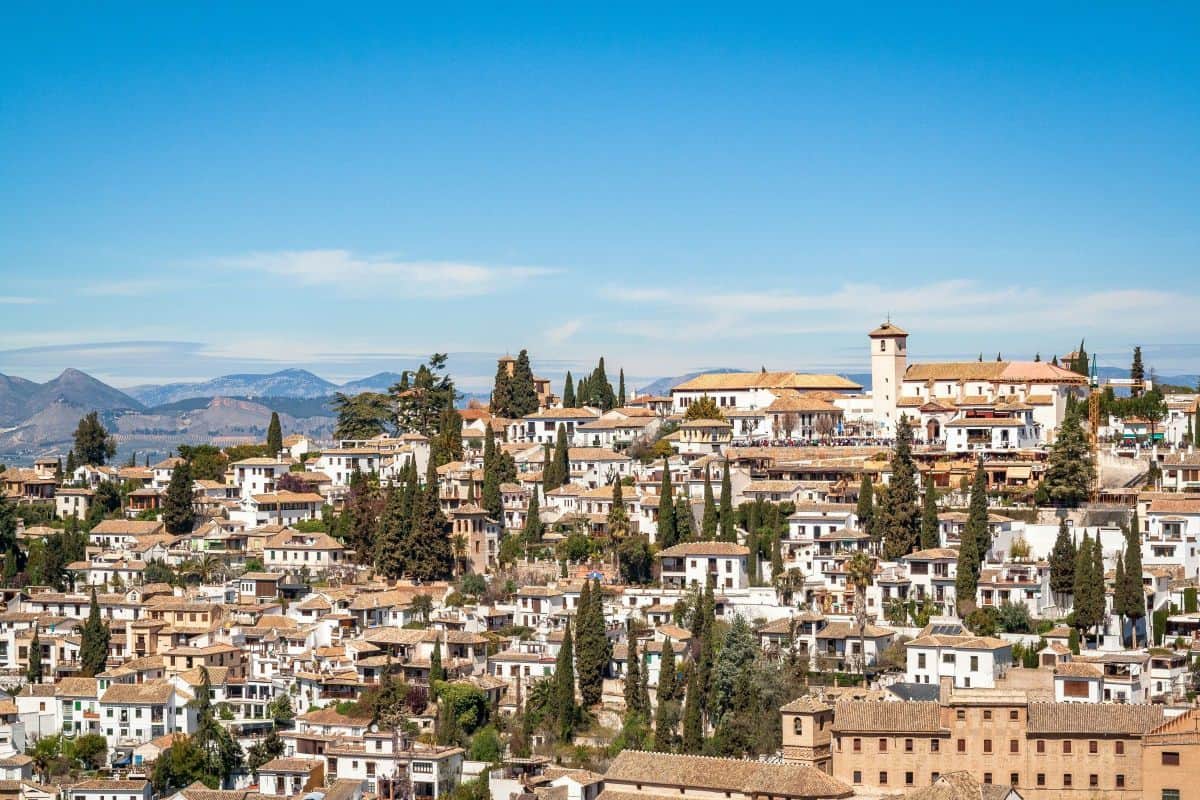
Scenic view of Granada featuring historic architecture and the Alhambra fortress in the background.
🌆 Granada City Centre
Cathedral and Royal Chapel
Granada Cathedral was begun in 1523 on the site of the main mosque, immediately after the Christian conquest. The adjacent Royal Chapel (Capilla Real) is the burial site of Ferdinand and Isabella — the monarchs who completed the Reconquista, funded Columbus’s expedition, and expelled both the Jews and (later) the Moors from Spain. Their marble tombs are here, along with the gold crown of Isabella and the sword of Ferdinand. Entry is €5 for the chapel, €5 for the cathedral. 30–45 minutes combined.
Alcaicería
The former Moorish silk market, now a small covered bazaar selling ceramics, leather, and craft goods. Touristy but the building is genuine — a reconstruction of the original 14th-century Moorish market that burned down in the 19th century. Good for shopping if you want traditional Granada crafts: taracea (marquetry woodwork), hand-painted ceramics, silk goods.
Free tapas culture
Granada is one of the last cities in Spain where ordering a drink automatically includes a free tapa. This is not a tourist gimmick — it’s the local norm. A beer (€2–2.50) comes with a small dish of food. Order three or four rounds and you’ve effectively eaten lunch for the price of drinks. The tapas improve as the day goes on and the kitchen gets into its stride. Calle Navas and the streets around Plaza Nueva are the main bar zones.
Day Trip from Málaga — Practical Information
By car
158 km via the A-92 motorway. 1 hour 30 minutes. Parking in central Granada is difficult and expensive — the Park & Ride at Estadio de Los Cármenes (free, southern edge of the city) runs a regular bus to the centre. Alternatively, park at Parking Alhambra (€3/hour, walk to the palace entrance) if your priority is the Alhambra and you’re arriving early.
By AVE train
1 hour 20 from Málaga María Zambrano to Granada. €25–45 depending on booking time. Book at renfe.com. Granada station is about 1.5 km from the city centre — taxi (€8–10) or bus to Plaza Nueva.
By private tour
We run private Granada day tours from Málaga and Marbella — door-to-door hotel pickup, English-speaking driver-guide, official Alhambra guide on the ground, and Alhambra tickets included from our licensed operator allocation. The day is structured around your specific Nasrid timed-entry slot. From €800/group for 2 people.
Private Granada & Alhambra Day Trip → · From €800/group · Alhambra tickets included · Hotel pickup from Málaga or Marbella · WhatsApp +34 651 026 027
Best Time to Visit Granada
| Month | Temp | Notes |
|---|---|---|
| April–June | 18–26°C | Best overall — comfortable, lower crowds than summer, Sierra Nevada still snowy for backdrop photos |
| July–August | 32–38°C | Hottest months — arrive early (before 9 AM), avoid midday outdoor walking. Alhambra sells out furthest ahead. |
| September–October | 22–28°C | Excellent — crowds thin after August, temperatures drop, harvest season in the surrounding countryside |
| November–March | 8–15°C | Cold — Granada sits at 685 metres and gets genuine winter. Alhambra available with 1–2 weeks notice. Atmospheric but bring a proper coat. |
Note that Granada’s altitude (685 metres) makes it noticeably cooler than the coast year-round. Even on a 35°C day in Málaga, Granada may be 28°C. In winter it gets cold enough to snow.
Suggested Day Itinerary from Málaga
| 8:30–9:00 AM | Depart Málaga (private tour or AVE train) |
| ~10:30 AM | Arrive Granada — Alcazaba first (least crowded in the morning) |
| 11:00 AM | Nasrid Palaces (timed entry — the day is structured around this slot) |
| 1:00 PM | Generalife gardens |
| 2:00 PM | Lunch in Granada — free tapas bars around Plaza Nueva |
| 3:30 PM | Albaicín quarter — Calle Calderería, Mirador de San Nicolás |
| 5:00 PM | Depart Granada |
| 6:30–7:00 PM | Return to Málaga or Marbella |
Frequently Asked Questions
Is Granada worth visiting from Málaga?
Yes — the Alhambra is one of the great buildings in Europe and is not replicated anywhere else. The Albaicín is one of the most intact medieval Moorish urban quarters in the world. Granada requires a full day (9–10 hours from Málaga) and advance planning for Alhambra tickets, but most visitors say it was the highlight of their Andalusia trip.
How far is Granada from Málaga?
158 km — 1 hour 30 by car via the A-92, or 1 hour 20 by AVE high-speed train from Málaga María Zambrano. From Marbella it’s 185 km and approximately 2 hours by car.
Do I need to book Alhambra tickets in advance?
Yes — in high season (April–October), Alhambra general tickets sell out 2–3 months ahead. Book at tickets.alhambra-patronato.es. If tickets are sold out, licensed tour operators (including us) have a separate allocation — contact us with your dates and we’ll check availability.
What is the Nasrid Palaces timed entry?
The Nasrid Palaces section of the Alhambra requires a specific 30-minute entry window shown on your ticket. You must arrive at the palace entrance within that window — early means being turned away, late means losing access entirely for the day. The Alcazaba and Generalife have no timed entry. On a private tour with us, the entire day is structured around your Nasrid slot.
Can I visit Granada and the Alhambra in one day from Málaga?
Yes — a full day (9–10 hours from Málaga) covers the Alhambra properly (Nasrid Palaces, Alcazaba, Generalife), lunch, and a walk through the Albaicín. It’s a long but not exhausting day. From Marbella the day is slightly longer (2 hours each way vs 1h 30 from Málaga).
Is Granada good to visit in winter?
Yes — the Alhambra is accessible year-round and tickets are much easier to get in winter (1–2 weeks notice vs 2–3 months in summer). Granada is cold in winter (8–15°C, occasional snow) and the Sierra Nevada is ski-able from December. The city has a cosy character in the cold months that summer doesn’t have.
Ready to Visit Granada?
We run private Granada day trips from Málaga and Marbella with Alhambra tickets included from our operator allocation — door-to-door hotel pickup, official Alhambra guide, Albaicín walk, and the day structured around your Nasrid timed-entry slot. If tickets are already sold out on the official site, WhatsApp us your dates and we’ll check what we have. See tour details and pricing → · See our complete Granada day trip guide for the full planning breakdown · Still deciding? See our Ronda vs Granada comparison.


About Us
We offer Quality Tours at affordable prices.
Costa Excursions is a boutique tour operator specialized in organizing the most wonderful private day tours and private shore excursions in Malaga and Costa del Sol.
The Connecto website interview Costa Excursions – you can read it here.


