
The short answer is yes — but not for the reasons most people expect, and not if you spend the whole week on the beach. The Costa del Sol has an image problem: everyone knows about the beaches, the golf courses, and the celebrity reputation of Marbella. Fewer people know about Ronda 65 km inland, the Alhambra 158 km away, the white villages of the Axarquía, or the fact that you can see Morocco on a clear day from a village 30 minutes from your hotel. This guide gives you the honest picture.
🎯 Key Takeaways
- Worth it for beach + culture: 320 sunny days a year, excellent beaches, and Ronda, Granada, and Gibraltar all within 2 hours.
- Not worth it if: you want authentic Spanish city life — Málaga city yes, but the resort strip is international, not Spanish.
- Best base: Marbella for the beach experience, Málaga city for culture and value.
- Best months: May, June, September, October — warm sea, no extreme heat, manageable crowds.
- The real reason to go: The day trips. Ronda in an hour, Gibraltar in 90 minutes, Granada in 2 hours. Nothing else in Europe gives you this combination from a beach base.
⚡ TL;DR
Yes — the Costa del Sol is worth visiting, especially as a beach base with day trips built in. The beaches are genuinely good, the weather is the best in mainland Europe, and within 2 hours you have the Alhambra, the Ronda gorge, Gibraltar with wild monkeys, the Nerja Caves, and the Caminito del Rey cliffside boardwalk. The resort strip itself is international rather than distinctly Spanish — but Málaga city and the mountain villages behind the coast are the real thing. Go in May, September, or October.
The Costa del Sol stretches 150 km along the southern coast of Spain between Málaga and Gibraltar. It gets 320 days of sun per year, has sea temperatures that stay swimmable from May through October, and sits within reach of some of the most extraordinary landscapes and historical sites in Europe. It also has a 1960s mass-tourism legacy — concrete apartment blocks, golf course developments, a reputation as the place where British expats go to drink in the sun — that has defined how people think about it for decades.
Both things are true simultaneously. The question is which version of the Costa del Sol you’re going to get, and that depends almost entirely on where you stay, how you spend your time, and whether you look inland.

Scenic view of Málaga’s port, city, and surrounding mountains from the historic hilltop.
Table of Contents
What the Costa del Sol Actually Is
The Costa del Sol is not one thing. It’s a 150-km stretch of coastline that includes:
- Torremolinos and Benalmádena — the 1960s package holiday resorts. High-rise, busy, cheap, and genuinely fun if that’s what you want. The original Costa del Sol that gave it its reputation.
- Fuengirola — family-friendly, less frenetic than Torremolinos, a large resident British and Northern European expat community.
- Marbella and the Golden Mile — international five-star hotel territory, Puerto Banús marina, the celebrity and money reputation. Genuinely beautiful coastline and old town.
- Málaga city — a real Spanish city with the Alcazaba, the Picasso Museum, one of the best tapas and restaurant scenes in Andalusia, and a character completely distinct from the resort strip.
- Nerja and the eastern Costa del Sol — quieter, less developed, more character. The Balcón de Europa, the Nerja Caves, the villages of the Axarquía behind.
- The mountains behind the coast — the Serranía de Ronda, the Sierra de las Nieves, the Sierra de Almijara. Ronda, Frigiliana, Competa, Mijas. The Costa del Sol that most visitors never find.
If you stay in Torremolinos and spend the week on the beach, you’ll have a beach holiday in the sun. If you base yourself in Málaga or Marbella and use the coast as a base for exploring the region, you’ll have something significantly more interesting.
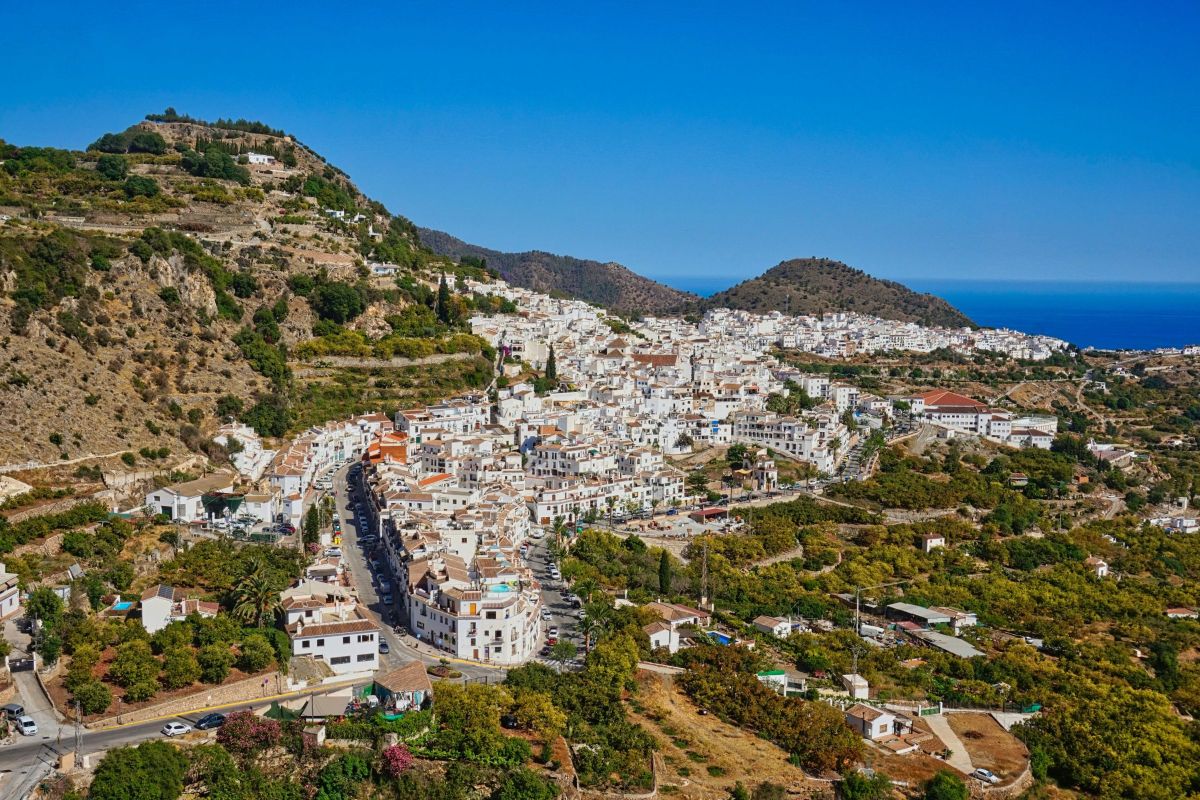
A picturesque coastal town in Costa del Sol with white buildings and lush green hills.
The Honest Case For Visiting
☀️ The weather is genuinely exceptional
320 sunny days per year. That’s not marketing copy — it’s the meteorological average. The Costa del Sol is protected from cold northerly winds by the Sierra Nevada and the Serranía de Ronda, which is why it gets more sun than almost anywhere else in mainland Europe. May through October the sea is swimmable (19–26°C). November through April it’s mild enough for outdoor lunches on most days. There is no other destination in mainland Europe with this weather profile.
🏖️ The beaches are good
Not Maldives good. Not Caribbean good. But genuinely good — long stretches of dark sand (volcanic origin), clean water, well-managed, with the full range of beach restaurants, facilities, and beach clubs. The beaches at Nerja (particularly Playa de Maro) and Marbella (Playa de la Fontanilla, Playa de Cabopino) are among the best in Spain.
🍽️ The food is seriously underrated
Málaga province has two Michelin-starred restaurants (Skina in Marbella, José Carlos García in Málaga), a tapas culture that extends well beyond tourist areas, and some of the best fresh fish in Spain — the fritura malagueña (mixed fried fish platter) in a seafront restaurant in Nerja or Málaga is a genuinely excellent thing. The wine region of the Serranía de Ronda — 20 minutes from Ronda — produces biodynamic wines from ancient native grape varieties that are only now being recognised internationally.
📍 The day trip access is the real argument
This is the specific thing that makes the Costa del Sol different from any other beach destination in Europe — and the thing that most people don’t factor into their decision. Within 2 hours of Marbella or Málaga:
- Ronda (65 km from Marbella, 1 hour) — one of the most dramatic towns in Spain. 98-metre gorge, oldest bullring in Spain, Moorish old town, water mine carved into the cliff face.
- Gibraltar (90 km from Marbella, 1h 15) — Europe’s only wild monkey population, views to Morocco 14 km across the Strait, a completely different country in a day.
- Granada & the Alhambra (185 km from Marbella, 2 hours) — one of the great buildings in the world. The Nasrid Palaces have no architectural equivalent in western Europe.
- Nerja Caves (55 km from Málaga, 50 min) — Guinness World Record stalactite column, 40,000-year-old prehistoric paintings, 18°C year-round.
- Caminito del Rey (60 km from Málaga, 1 hour) — a 7.7 km cliffside boardwalk 100 metres above the river in places. The best active day out in southern Spain.
- White villages — Mijas, Frigiliana, Setenil de las Bodegas, Competa. All within an hour, all genuinely Andalusian, all dramatically different from the coast below.
No other beach destination in Europe gives you this range of genuinely significant experiences within a day’s reach. The Costa del Sol beach is the base. The region is the experience.

Explore the scenic beauty of Andalusia’s countryside with Costa Excursions’ private day trips.
The Honest Case Against
The resort strip is not distinctly Spanish
If you stay in Torremolinos or Fuengirola and want to experience authentic Spanish culture — local restaurants, Spanish-speaking staff, Andalusian character — you’ll find it but you’ll have to look for it. The dominant culture on the resort strip is British expat and international tourist. English menus, British pubs, fish and chips, English-language TV. This is what the market developed around and it’s what many of the larger hotels still deliver.
The solution is straightforward: base yourself in Málaga city or Marbella old town rather than the resort strip, and use the white villages and Ronda for the Andalusian character you’re looking for. But if you’re expecting the Costa del Sol resort experience to feel like “authentic Spain,” you’ll be disappointed.
July and August are very crowded
The Costa del Sol receives the majority of its annual visitors in July and August. The beaches are packed, the roads are congested, the restaurants are queued, and accommodation prices peak. Inland destinations (Ronda, Granada) hit 35–38°C in July and August, which makes day trips uncomfortable at midday.
None of this makes it not worth visiting in summer — but the experience in July is materially different from May. If you have flexibility, avoid peak summer. If school holidays dictate your timing, plan around the heat (early morning day trip departures, beach afternoons) and book everything well in advance.
Some parts are overbuilt
The stretch between Torremolinos and Fuengirola has significant concrete development from the 1960s and 70s that hasn’t aged well. This is not the whole coast — Nerja, Marbella old town, and the mountain villages are beautiful — but parts of the Costa del Sol look exactly like the photographs that critics use to dismiss it. Don’t base yourself in those parts if aesthetics matter to you.
Who the Costa del Sol Is Best For
| Traveller type | Worth it? | Why |
|---|---|---|
| Families with children | ✅ Yes | Safe beaches, Gibraltar monkeys, Nerja Caves, Mijas burro taxis — all genuinely engaging for children |
| Couples — beach + culture | ✅ Strongly yes | Ronda Winery & Tapas, Granada at dusk, Michelin restaurants in Marbella, white villages |
| Solo travellers | ✅ Yes | Málaga city specifically — genuine city life, good restaurant scene, affordable |
| Active travellers | ✅ Yes | Caminito del Rey, hiking in the Serranía de Ronda, cycling the coast road |
| Cruise passengers | ✅ Yes | Málaga port is perfectly positioned — Ronda in 8 hours, Mijas in 4 hours |
| “Authentic Spain” seekers | ⚠️ Depends | Málaga city and the white villages: yes. The Torremolinos strip: no. |
| Pure beach holiday | ✅ Yes | Excellent beaches, best weather in Europe, affordable beach clubs |
| City break only | ⚠️ Consider Seville or Granada instead | Málaga is a good city but Seville and Granada have more to see in 3 days |
Costa del Sol vs Other Spanish Destinations
Costa del Sol vs Barcelona
Barcelona has the architecture (Gaudí), the food scene, and the city culture. The Costa del Sol has better beaches, better weather, and the Andalusian hinterland. If your priority is city culture: Barcelona. If your priority is beach + day trips in the sun: Costa del Sol. Many visitors do both in one trip — Barcelona north, fly in or out of Málaga south.
Costa del Sol vs the Canary Islands
The Canaries (Tenerife, Gran Canaria, Lanzarote) have similar or slightly better winter weather than the Costa del Sol and excellent beaches. What they don’t have is the mainland Andalusia day-trip access. If you’re going in winter primarily for sun and beach: Canaries might suit you better. If you want to combine beach with the Alhambra, Ronda, and Gibraltar: Costa del Sol.
Costa del Sol vs the Algarve (Portugal)
The Algarve has more dramatic cliff scenery and marginally better Atlantic beaches. The Costa del Sol has more sun, warmer sea temperatures, and significantly better access to inland cultural destinations. The Algarve doesn’t have Ronda, Gibraltar, or the Alhambra within day-trip reach.
Best Time to Visit the Costa del Sol
| Month | Worth visiting? | Why |
|---|---|---|
| May | ⭐⭐⭐⭐⭐ Best | 22–24°C, sea 19°C, minimal crowds, full choice of accommodation |
| June | ⭐⭐⭐⭐ Excellent | 26–28°C, sea 22°C, long evenings, busy but not overwhelming |
| September | ⭐⭐⭐⭐⭐ Best | 26–29°C, sea 24°C (warmest of year), crowds gone, prices drop |
| October | ⭐⭐⭐⭐ Very good | 22–24°C, sea 22°C, quiet, great light for photography |
| July–August | ⭐⭐⭐ Good with caveats | Warmest sea, most atmosphere — but crowded, expensive, hot inland |
| November–March | ⭐⭐⭐ Good for non-beach | Mild (15–18°C), quiet, cheap — not for swimming but fine for exploring |
| April | ⭐⭐⭐ Mixed | Variable weather, sea still cool — improving through the month |
Frequently Asked Questions
Is the Costa del Sol worth visiting?
Yes — especially for visitors who combine beach time with day trips inland. The beaches are excellent and the weather is the best in mainland Europe. Within 2 hours of Marbella or Málaga are Ronda (98-metre gorge, oldest bullring in Spain), Gibraltar (wild monkeys, views to Africa), Granada and the Alhambra (one of the great buildings in Europe), the Nerja Caves, and the white villages of Andalusia. No other beach destination in Europe offers this range of day-trip options.
Is the Costa del Sol touristy?
Parts of it are very touristy — Torremolinos, parts of Fuengirola, and the most commercial sections of Marbella’s seafront. Málaga city, Marbella old town, Nerja, and the mountain villages behind the coast are significantly less so. The key is choosing where to base yourself and being willing to go beyond the resort strip.
Is the Costa del Sol better than the Algarve?
Different rather than better. The Algarve has more dramatic cliff scenery. The Costa del Sol has more sun, warmer sea temperatures in shoulder season, and far better access to inland destinations — Ronda, Granada, and Gibraltar are all within 2 hours of Marbella. If day trips to genuine historical and cultural destinations matter to you, the Costa del Sol wins clearly. If dramatic coastal scenery is your priority, the Algarve competes.
What is the best part of the Costa del Sol to stay?
Marbella for the classic Costa del Sol beach experience — Golden Mile hotels, Puerto Banús, excellent beaches, best day-trip access to Ronda (65 km) and Gibraltar (90 km). Málaga city for a more authentic Spanish experience — Picasso Museum, Alcazaba, excellent restaurant scene, good transport connections. Nerja for something quieter and more characterful — less developed, Balcón de Europa, easy access to the Nerja Caves and Frigiliana.
Is the Costa del Sol worth it in winter?
Yes if you’re not specifically coming for beach swimming. Winter temperatures average 15–18°C — cold enough for a jacket in the evening, warm enough for outdoor lunches most days. Ronda in winter, with cold clear air and almost no tourists, is a completely different and arguably better experience than summer Ronda. Málaga city in winter has a peaceful, local atmosphere. The sea is too cold for most people to swim from November through April.
How many days do you need on the Costa del Sol?
Minimum 5 days to do it justice — 1–2 beach days, 2 day trips (Ronda and Gibraltar or Nerja), and at least one day in Málaga city or a white village. 7–10 days allows you to add Granada, the Caminito del Rey, and multiple villages without rushing. A week in Marbella with 2–3 private day trips is the most consistent format for first-time visitors.
Final Thoughts
The Costa del Sol is worth visiting — consistently and for the right reasons. The beach is good. The weather is the best in mainland Europe. And the region behind the coast is extraordinary. Ronda, Gibraltar, Granada, the Nerja Caves, the white villages — none of these are more than 2 hours from your hotel in Marbella or Málaga. If you use the coast as a base rather than the destination, you’ll leave having seen more of Andalusia in a week than most people see in two trips. We run private day tours to all of these destinations from Marbella and Málaga — browse all tours → or WhatsApp us at +34 651 026 027 to plan your days.