We’ve watched hundreds of guests photograph the Puente Nuevo over the years, and the pattern is almost always the same: they arrive at the obvious spot, take the obvious shot everyone’s seen a thousand times, and move on without knowing there were four better angles within a five-minute walk. This guide is what we’d tell a friend with a camera — where to stand, what time to be there, and which of Ronda’s viewpoints actually earn the walk.
None of this requires professional equipment. A phone camera handles most of what’s below perfectly well, provided you’re in the right place at the right time. That’s really the whole game in Ronda — light and position matter more than gear.
Table of Contents
Understanding Ronda’s Light
Before the specific viewpoints, it helps to understand why timing matters as much as it does here. Ronda sits on a plateau split by the El Tajo gorge, running roughly east to west, with the Puente Nuevo crossing the narrowest point. That orientation means the gorge catches direct sun very differently depending on the hour — the walls that glow warm gold at 5 PM are the same walls sitting in flat, uninteresting shadow at noon.
The altitude adds something too. At 723 metres, the air is clearer than on the coast, which means the light itself has more contrast and saturation — colours read more vividly in a Ronda photograph than the same scene would at sea level, particularly in the golden hours around sunrise and sunset.
If you take one piece of advice from this whole guide: avoid shooting the main viewpoints between roughly 12 PM and 3 PM. The light is flat, the shadows are harsh and unflattering, and every angle looks worse than it will an hour either side of that window.

A stunning aerial shot of Ronda, highlighting its famous bridge and scenic landscape during sunset.
Mirador de Aldehuela — The Classic Shot, Done Right
This is the viewpoint on the new town side of the bridge, and it’s where almost every published photo of the Puente Nuevo comes from — the head-on view with the full 98-metre drop visible beneath the arches. It’s the obvious spot for a reason: the composition genuinely works.
The mistake most visitors make here is showing up at 11 AM or noon, when the sun is high and the gorge walls fall into flat shadow beneath the bridge. Morning light, roughly 9–10:30 AM, hits the bridge from an angle that models the stonework properly — you get texture and depth instead of a silhouette. If you can only visit once, this is the window.
Practical note: this viewpoint gets crowded fast once coach tours arrive, typically from 10:30 AM onward. Arriving right at opening, or accepting a slightly flatter shot later in the day when the crowds thin, are the two realistic trade-offs.

Experience the stunning vistas of Ronda’s cliffs and verdant surroundings, perfect for sightseeing and outdoor adventures.
Jardines de Cuenca — The Better Photograph Most People Miss
On the old town side of the gorge, accessed via Calle Marqués de Salvatierra, the Jardines de Cuenca are hanging gardens built along the cliff edge. This is where you get the lateral view of the bridge — its full height in profile, with the gorge walls and the river visible below, rather than the head-on angle from Aldehuela.
Photographers who know Ronda tend to rate this view higher than the classic postcard shot, and it’s easy to see why once you’re standing there. The composition has more depth, and because fewer casual visitors make the walk down from the main square, you’ll often have it largely to yourself even when Aldehuela is packed.
The best light here runs from early afternoon into the 1:30–3 PM window specifically — an inversion of the general “avoid midday” rule above, because this angle catches the sun face-on rather than from the side. It’s one of the only spots in Ronda where the harsh midday light actually works in your favour rather than against you.
Puente Viejo — The Bridge Nobody Photographs
Most visitors photograph the Puente Nuevo and never notice the older, smaller bridge nearby — the Puente Viejo, dating to the 16th century, a more modest stone crossing lower down the gorge. It doesn’t have the scale of its famous neighbour, but that’s part of the appeal: quieter, less staged, and a genuinely different texture from the postcard version of Ronda most people bring home.
Late afternoon light works best here, when the sun angles down into the gorge and catches the older stonework at a low, warm angle.
Inside the Gorge — The Desfiladero del Tajo
Since the Desfiladero del Tajo walkway opened in phases from April 2024, there’s a genuinely new photograph available in Ronda that didn’t exist for previous generations of visitors: the Puente Nuevo from below, looking up at the full 98-metre elevation from the gorge floor rather than down from a viewpoint. It’s a different kind of shot entirely — more about scale and vertigo than the classic wide composition.
Midday works reasonably well here specifically, since you’re shooting upward into open sky rather than across a shadowed gorge wall, though the tunnel section beneath the bridge itself requires a wider aperture or a steady hand given the low light. Full details on the walkway itself are in our Desfiladero del Tajo guide.
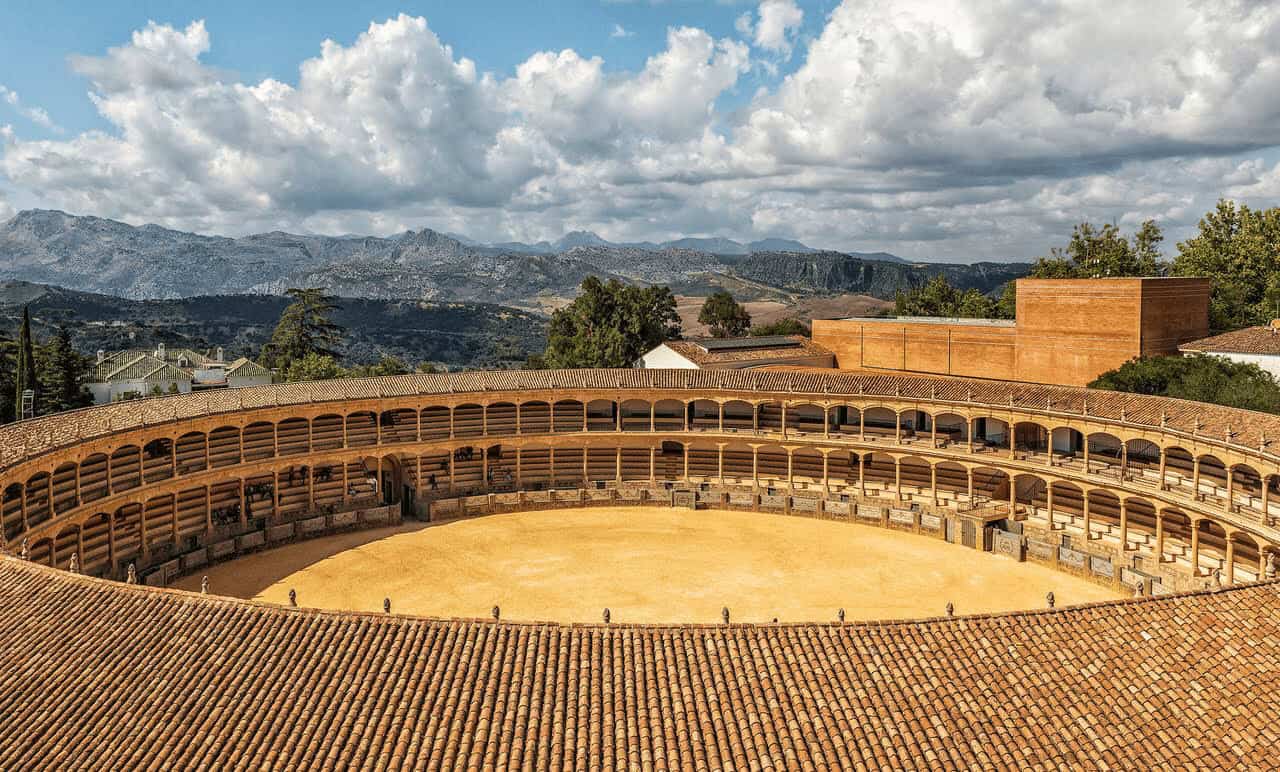
Explore the iconic Ronda bullring and enjoy breathtaking views during your private day trip to Ronda.
Plaza de Toros Terrace — Mountains, Not Gorge
A different kind of photograph entirely. The terrace at the Plaza de Toros — Ronda’s 1785 bullring, the oldest in Spain — looks west across open countryside toward the Serranía de Ronda rather than into the gorge. Late afternoon and early evening give the best light here, when the mountains catch warm colour and the terrace itself, still lit, provides good foreground interest.
Inside the ring, midday light through the open roof creates strong, graphic shadows across the sand — a completely different mood from the soft golden-hour shots elsewhere on this list, and worth a frame if strong contrast and clean geometric lines are more your style than the classic warm gorge shot.
Casa del Rey Moro Water Mine — Low Light, Different Rules
Inside the water mine, natural light disappears almost entirely within the first 50 steps down. This isn’t a golden-hour location — it’s a low-light, atmospheric one, and the photographs that work here are different in character from everything above: dark stone, narrow shafts of light where the staircase catches an opening in the rock, a sense of scale that comes from including a person in the frame rather than trying to capture the whole space at once.
A phone camera’s night mode handles this reasonably well if you’re patient and hold steady; a proper camera with a fast lens does better still. Either way, this is the one spot on the list where timing doesn’t matter — the light inside is roughly constant regardless of what time you arrive at the entrance above.
The Old Town Streets — Golden Hour, Any Direction
Beyond the specific viewpoints, Ronda’s old town (La Ciudad) rewards unplanned wandering with a camera more than almost anywhere else on the Costa del Sol. Whitewashed walls catch and bounce late-afternoon light in a way that makes even an ordinary street corner look considered. There’s no single “best” spot here — the advice is simply to walk without a fixed plan in the hour before sunset and let specific doorways, plant pots, and light angles catch your attention as you go.
Seasonal Notes
Spring (April–May) brings the clearest air of the year and wildflowers across the surrounding countryside, visible from the mountain-facing viewpoints like the Plaza de Toros terrace. Autumn (September–October) offers similar clarity with a slightly warmer colour temperature to the light. Summer’s harsh midday sun makes the “avoid noon” rule even more important than usual — the contrast becomes genuinely difficult to work with, not just unflattering. Winter, counterintuitively, can produce some of the best photographs of the year: clean, cold light, dramatically fewer people in every frame, and occasional low cloud sitting in the gorge itself, which is a shot worth chasing if you happen to catch it.
A Realistic One-Day Photography Route
| Time | Location | Why |
|---|---|---|
| 9:00–9:45 AM | Mirador de Aldehuela | Best light on the classic view, before crowds |
| 9:45–10:30 AM | Casa del Rey Moro water mine | Light-independent, good next stop |
| 10:30–11:30 AM | Old town wandering | Softer light window, doorways and details |
| 1:30–2:30 PM | Jardines de Cuenca | One of the few spots midday light actually helps |
| 2:30–3:30 PM | Desfiladero del Tajo | Overhead light suits the upward gorge shot |
| 5:30–7:00 PM | Plaza de Toros terrace, then old town | Golden hour on the mountains and whitewashed streets |
What to Bring
A phone with a recent camera handles almost everything on this list competently, including low-light and night modes for the water mine. If you’re bringing a dedicated camera, a mid-range zoom (roughly 24–70mm equivalent) covers most of what you’ll want without needing to swap lenses on a cliff edge. A polarising filter helps noticeably at the main viewpoints in bright midday conditions, cutting haze and deepening the sky. Comfortable shoes matter more than any piece of camera equipment — several of these spots involve uneven cobbled ground and some genuine walking between them.
Want a guide who knows the timing?
Our private Ronda tours can be timed around the light if photography matters to your day — tell us when booking and we’ll plan the route accordingly. See tour details → · from €600/group · WhatsApp us at +34 651 026 027
Frequently Asked Questions
What is the best viewpoint for photographing the Puente Nuevo?
Mirador de Aldehuela, on the new town side, gives the classic head-on view with the full 98-metre drop visible. Jardines de Cuenca, on the old town side, gives the lateral profile view many photographers consider more interesting, and is typically less crowded.
What time of day is best for photography in Ronda?
Generally early morning (9–10:30 AM) or the hour before sunset, avoiding the flat, harsh light of midday at most viewpoints. The main exception is Jardines de Cuenca, where early afternoon light actually works well due to the angle of the sun relative to that specific viewpoint.
Is the Casa del Rey Moro water mine good for photography?
Yes, but it requires a different approach — natural light disappears quickly inside, so this is a low-light, atmospheric location rather than a golden-hour one. A phone’s night mode or a camera with a fast lens both work; timing doesn’t matter since the interior light is roughly constant.
Do I need professional camera equipment to photograph Ronda well?
No — a modern phone camera handles most of what Ronda offers, provided you’re in the right place at the right time. Light and position matter far more than equipment for the classic viewpoints.
What is the best season for photography in Ronda?
Spring and autumn offer the clearest air and best overall light quality. Winter can produce dramatic, uncrowded photographs with occasional low cloud in the gorge. Summer’s harsh midday sun makes timing around golden hour more important than in other seasons.