Setenil de las Bodegas is a village where people have been living inside rock overhangs for over 2,000 years. The cliff face forms the ceiling of entire streets — houses, restaurants, tapas bars all carved into or built under the rock. It’s 117 km from Málaga, 25 minutes from Ronda, and one of the most visually distinctive places in Andalusia. Most visitors stumble across it by accident. Here’s how to go on purpose and do it properly.
🎯 Key Takeaways
- Setenil is 117 km from Málaga (1h 50) and 25 minutes from Ronda — best combined with Ronda in one day.
- The village has two famous rock-overhang streets: Calle Cuevas del Sol and Calle Cuevas de la Sombra.
- Allow 2 hours to walk the village properly — it’s small but dense with things to see.
- No advance booking needed for anything — everything is walk-in.
- The Roman ruins at Acinipo are 15 minutes away and free to visit — worth adding if you have time.
⚡ TL;DR
Setenil de las Bodegas is a small Andalusian village where the houses are built into rock overhangs — the cliff is the roof and wall. It takes 2 hours to walk properly. It’s too small for a standalone day trip from Málaga but pairs perfectly with Ronda (25 min away) for a full day. No booking needed. Best combined as Ronda in the morning, Setenil in the afternoon.
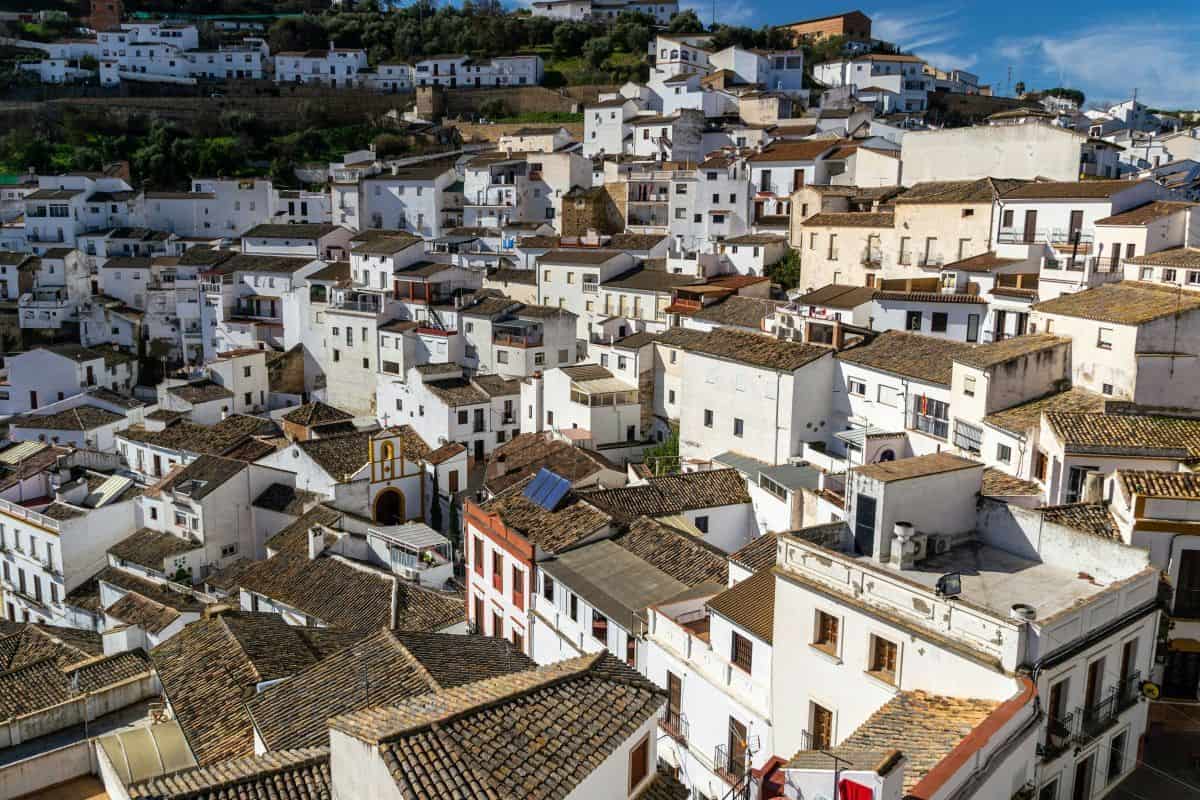
A picturesque view of Setenil de las Bodegas, a charming Andalusian village famous for its rock-embedded architecture.
Table of Contents
Setenil de las Bodegas: Day Trip Guide from Málaga and the Costa del Sol (2026)
The photographs of Setenil look like something has gone wrong with the architecture. Streets where the rock face overhead IS the ceiling. Houses wedged under overhangs with barely a metre of clearance above the door. Tapas bars where the back wall is raw limestone. It’s real — people have been living in these caves and under these overhangs since before the Romans arrived, and the town that grew around them looks like nothing else in Spain.
Setenil is 117 km from Málaga and 25 minutes from Ronda. It’s small — you can walk the whole historic centre in 90 minutes — so it doesn’t make sense as a standalone day trip from the coast. But combined with Ronda, it makes one of the best full-day combinations in Andalusia. This guide covers the village properly, how to get there, how to combine it, and what to eat.
Setenil at a Glance
| Distance from Málaga | 117 km / 1h 50 by car |
| Distance from Ronda | 18 km / 25 min by car |
| Distance from Marbella | 100 km / 1h 30 by car |
| Population | ~3,000 |
| Altitude | 660 metres |
| Time needed | 2 hours (village only) / 3 hours with Acinipo |
| Best combined with | Ronda (25 min away) |
| Advance booking required | Nothing — fully walk-in |
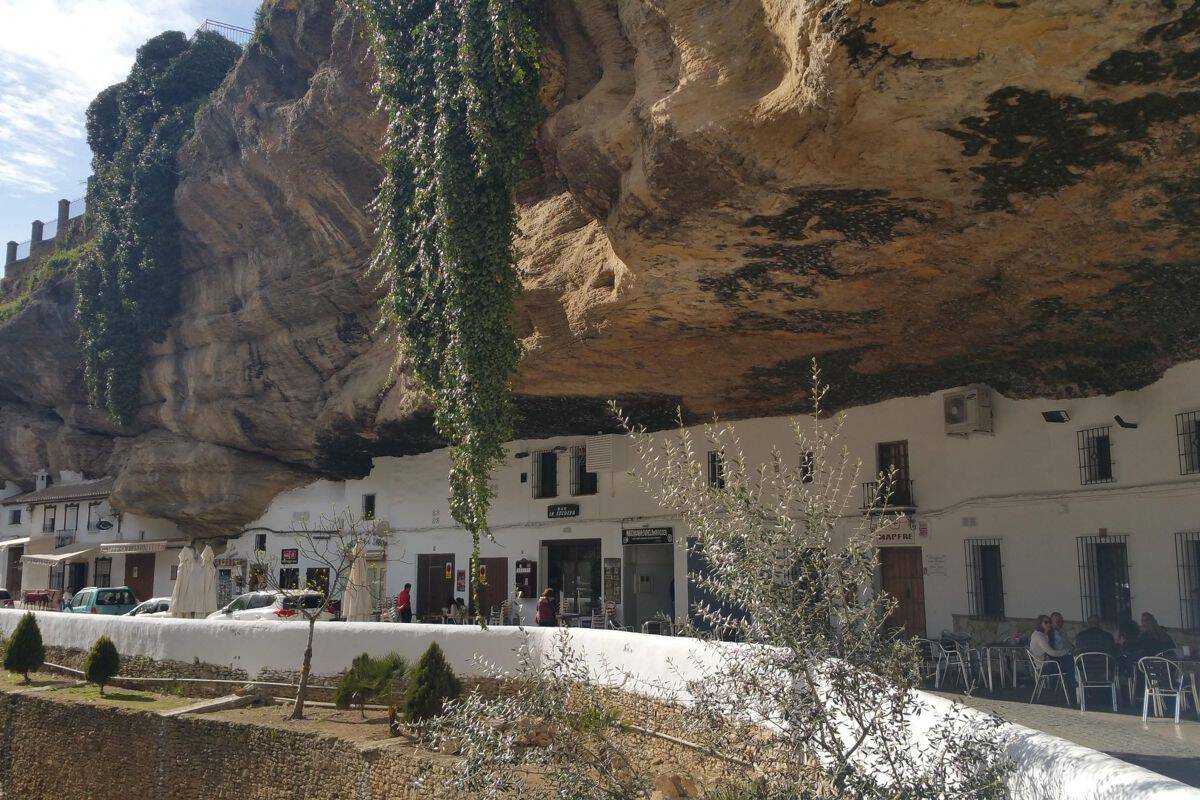
Traditional cave dwellings of Setenil de las Bodegas nestled under a large rock overhang, showcasing Andalusian architecture.
What Makes Setenil Different
Most white villages in Andalusia look broadly similar from a distance — white houses on a hill, a church at the top, narrow streets. Setenil looks different at street level because of something that has nothing to do with architecture: the Trejo river carved a gorge through the rock here over millions of years, leaving overhanging cliff faces on both banks. The people who settled here didn’t fight the overhangs. They built into them and under them.
Two streets in particular are famous:
Calle Cuevas del Sol (Street of the Sun Caves)
The south-facing overhang — the warmer, sunnier side of the gorge. The rock above is lower here, sometimes just a metre or two above the rooftops. The street runs along the river with restaurants and tapas bars packed under the cliff face. This is the one in most photographs. In summer, the shade provided by the overhang makes it significantly cooler than the open streets above — exactly why people chose to build here originally.
Calle Cuevas de la Sombra (Street of the Shadow Caves)
The north-facing overhang on the opposite bank — darker, damper, more atmospheric. The rock here is higher and more dramatic, forming a cathedral-like space over the street below. Fewer tourists than Calle Cuevas del Sol, which means quieter and in some ways more impressive. Walk both and compare.
Beyond the two famous streets, the village extends up the hillside in the standard white-village pattern. The castle ruins at the top are worth the 10-minute climb for the view back down over the rock streets and the surrounding farmland. The Plaza de Andalucía in the centre has the town hall, the church, and a couple of decent tapas bars.

Discover the unique cave houses and narrow streets of Setenil de las Bodegas, a hidden gem in Spain known for its stunning rock formations.
What to Do in Setenil
Walk the rock-overhang streets
This is the whole point. Start at the car park by the river, walk along Calle Cuevas del Sol first (the sunny side, easier to photograph in morning light), then cross to Calle Cuevas de la Sombra. Look up at the rock face as much as you look at the buildings. The geology is the story — the layers of rock visible in the overhang show millions of years of sediment compressed into limestone, then cut through by the river. The houses are almost incidental.
Castillo de Setenil
The castle ruins at the top of the village date to the Almohad period (12th century) and were the site of one of the longest sieges in the Reconquista — Fernando the Catholic reportedly besieged Setenil for 15 days in 1484 before the town surrendered. The castle itself is ruined but the views from the top are good: the rock streets below, the surrounding plains, and on clear days the distant sierras. Entry is free. The 10-minute climb is worth it.
Iglesia de la Encarnación
The main church, built in the 15th century on the foundations of a mosque. Typical late-Gothic construction with some Renaissance additions. More interesting from outside than inside, but if it’s open it’s worth 15 minutes. The square in front is the main gathering point in town.
Tapas under the rock
Eating a plate of rabo de toro or ibérico cured meats at a table on Calle Cuevas del Sol — with the rock overhang above you and the river below — is one of the more unusual lunch settings in Andalusia. Most of the restaurants on both cave streets serve similar menus: local mountain food, cold cuts, cheese, grilled meats. Prices are lower than in Ronda. Bar Restaurante Palmero and El Mirador on Calle Cuevas del Sol are consistently recommended by locals.
Acinipo (optional add-on, 15 min from Setenil)
A 1st-century BC Roman city on a hilltop 15 km north of Setenil. Locals call it “Ronda la Vieja” (Old Ronda) because the Romans considered it more important than what is now Ronda. The site has a remarkably intact Roman theatre — the semicircular seating and stage structure still standing on the hilltop with views across the Serranía de Ronda. Entry is free. Almost always deserted. If you’ve got a car and the afternoon, it’s 30 minutes out of your day and unlike almost anything else in the region.

Scenic view of a whitewashed village street in Málaga, featuring a dramatic overhanging rock and vibrant greenery.
Getting to Setenil from Málaga and the Costa del Sol
By car
Setenil is 117 km from Málaga via the A-357 and A-374. About 1h 50. The road passes through Ardales (near Caminito del Rey) and then climbs into the Serranía de Ronda. The drive is good — varied landscape, not too winding after the initial climb. Parking in Setenil is at the riverside car park at the village entrance. Free.
From Ronda (recommended)
18 km / 25 minutes on the A-374. This is the logical way to do it — Ronda in the morning, Setenil in the afternoon. The road between them is straightforward.
By private tour
We combine Ronda and Setenil as a single day trip from Málaga and Marbella. Morning in Ronda (the gorge, old town, lunch), then 25 minutes to Setenil for the afternoon (rock streets, castle, coffee at a cave bar). Back in Málaga by 7 PM. It’s our most popular multi-village combination and the best way to see both without navigating mountain roads. See our private Ronda day tour page — Setenil can be added on request.
Public transport
There is a bus from Ronda to Setenil operated by Comes . From Málaga, public transport to Setenil requires a change in Ronda and is not practical for a day trip.
The Best Combination: Ronda + Setenil in One Day
This is the standard. Setenil is genuinely too small for a standalone day trip from Málaga — 2 hours is enough to see everything, which doesn’t justify a 3h 40 round trip from the coast. But as a second stop after Ronda, it’s ideal.
Suggested structure from Málaga:
- 8:30 AM — Leave Málaga
- 10:00 AM — Arrive Ronda. Walk to Mirador de Aldehuela for the first gorge view
- 10:30 AM — Cross Puente Nuevo into the old town
- 11:15 AM — Casa del Rey Moro (the 200-step water mine descent)
- 1:00 PM — Lunch in Ronda — gorge-view restaurant
- 3:00 PM — Drive to Setenil (25 min)
- 3:30 PM — Walk Calle Cuevas del Sol and Calle Cuevas de la Sombra
- 4:15 PM — Climb to the castle ruins
- 4:45 PM — Coffee and tapas at a cave bar
- 5:30 PM — Drive back to Málaga
- 7:00 PM — Back in Málaga
From Marbella, leave at 8:00 AM and the rest of the schedule works the same — Ronda is only 65 km from Marbella vs 100 km from Málaga.
Want to add Acinipo? Replace the castle climb in Setenil with a 15-minute drive to the Roman ruins instead. Same time, different experience — better for history enthusiasts, slightly less photogenic.

Charming view of Setenil de las Bodegas with whitewashed houses built into rocky cliffs, showcasing its unique architecture and scenic landscape.
What to Eat in Setenil
Mountain Andalusian food — the same as Ronda but cheaper and with fewer tourists. The cave restaurants on Calle Cuevas del Sol are the obvious choice for the atmosphere: sitting under a rock overhang with a plate of slow-cooked mountain food is the experience.
What to order:
- Rabo de toro — slow-braised oxtail, the mountain staple. Every restaurant in the area has it.
- Tabla de ibéricos — a board of cured Iberian meats (jamón, chorizo, salchichón) with local cheese. Excellent with a glass of local wine.
- Berenjenas fritas con miel — fried aubergines with honey or cane molasses. A classic of the region.
- Sopa castellana — a thick garlic and bread soup with egg, hearty and warming in cooler months.
- Local wine — ask for a glass of vino de la Serranía. The Ronda wine zone (DO Sierras de Málaga) is 25 minutes away; the local bars serve it.
Most restaurants on the cave streets are open from lunch (1:30 PM) until late afternoon. If you’re arriving after 4:30 PM, call ahead or check they’re still serving. Tapas bars stay open longer.
When to Visit
- April–June: The best time. The rock streets are cool and shaded, the surrounding farmland is green, crowds are manageable. Wildflowers on the hillsides above the village from March–May.
- September–October: Warm, dry, harvest season in the nearby wine country. Good light for photography.
- July–August: Hot inland (30–35°C) but the cave streets provide natural shade and stay significantly cooler than open streets. If you’re going in summer, the rock overhangs are actually one of the better places to be at midday.
- November–March: Cool and quiet. The village sees almost no tourists. On clear winter days, the air quality gives exceptional visibility across the Serranía de Ronda.
Best time of day: Morning light hits Calle Cuevas del Sol from the east — best for photography before noon. Afternoon is cooler and quieter in the cave streets. If you’re combining with Ronda, arrive in Setenil after 3 PM when the worst of the day-trip coaches have left.
Practical Tips
- Wear comfortable shoes — the village is hilly with cobblestones and uneven stone paths
- The cave streets are genuinely cool even in summer — bring a light layer in spring or autumn
- Free parking at the riverside car park at the village entrance — no parking inside the historic centre
- Cash is useful at smaller tapas bars although cards are increasingly accepted
- No entrance fees for anything in Setenil — the castle, the streets, all free
- Photography: Morning light on Calle Cuevas del Sol is best. The shadows and textures of Calle Cuevas de la Sombra are better in overcast light
- Mobile signal can be patchy inside the deep cave sections — download offline maps before you arrive
Frequently Asked Questions
What is Setenil de las Bodegas known for?
Setenil is known for its houses built into and under natural rock overhangs — entire streets where the cliff face forms the ceiling of the buildings below. The two most famous streets are Calle Cuevas del Sol and Calle Cuevas de la Sombra. It’s often cited as one of the most unusual villages in Spain for this reason.
How far is Setenil de las Bodegas from Málaga?
117 km from Málaga — approximately 1 hour 50 minutes by car via the A-357 and A-374. From Ronda it’s just 18 km / 25 minutes. From Marbella it’s approximately 100 km / 1h 30.
Is Setenil de las Bodegas worth visiting?
Yes, but it’s too small to justify a standalone day trip from Málaga — 2 hours covers the whole village comfortably. It’s absolutely worth it as a second stop combined with Ronda, which is only 25 minutes away. The rock-overhang streets are genuinely unlike anything else in Spain and the food under the caves is good.
How long do you need in Setenil?
2 hours is enough to walk both cave streets, climb to the castle, and have a coffee or tapas. Add 30–45 minutes if you want a proper sit-down lunch at one of the cave restaurants. 3 hours maximum before you start running out of things to see.
Can you combine Setenil with Ronda in one day?
Yes — this is the recommended combination. Ronda in the morning (5–6 hours for the gorge, old town, and lunch), then 25 minutes to Setenil for the afternoon (2 hours for the cave streets and castle). Back to Málaga by 7 PM from an 8:30 AM departure. It’s our most popular multi-village day trip combination.
What is Acinipo near Setenil?
Acinipo is a 1st-century BC Roman city 15 km north of Setenil, with a remarkably intact Roman theatre still standing on a hilltop with views across the Serranía de Ronda. Free to visit, almost always empty. Worth adding to the day if you have a car and interest in Roman history. Locals call it “Ronda la Vieja” (Old Ronda).
Is there public transport to Setenil from Málaga?
Not practical for a day trip. There is a bus from Ronda to Setenil, but from Málaga the journey requires a change in Ronda and the return connections are limited. Renting a car or booking a private tour with hotel pickup are the realistic options.
What should you eat in Setenil?
Rabo de toro (slow-braised oxtail) is the regional speciality. The cave restaurants on Calle Cuevas del Sol serve good mountain Andalusian food — cured meats, local cheese, grilled meats, and mountain soups. Prices are noticeably lower than in Ronda. Eating lunch at a table under the rock overhang is one of the more unusual dining experiences in Andalusia.
How do you get from Ronda to Setenil?
18 km on the A-374 — 25 minutes by car. The road is straightforward and well-signposted. There is also a bus service (check current schedules locally). By taxi from Ronda, expect €20–25 each way.
Is Setenil good for families with children?
Yes — the cave streets are short and fascinating for children, the castle ruin is easy to explore, and there’s no paid entry for anything. The village is small enough not to exhaust younger children. The walk up to the castle is 10 minutes on a gentle path.
Book a Private Ronda + Setenil Day Tour
We combine Ronda and Setenil as a single private day trip from Málaga, Marbella, and across the Costa del Sol. Morning in Ronda — the gorge, the old town, a proper lunch — then 25 minutes to Setenil for the cave streets in the afternoon. Door-to-door from your hotel, licensed local driver-guide, flexible pace. We’ve been running this combination for over 12 years.
- From €600 per group (up to 6 pax)
- Duration: ~10 hours
- Pickup: Málaga, Marbella, or any Costa del Sol hotel
Book the Private Ronda + Setenil Tour
Related Reading
- Day Trip from Málaga to Ronda — Complete Guide
- Ronda Must-See Attractions
- White Villages of Andalusia — Complete Guide
- Top 10 Wineries to Visit in Ronda
Final Thoughts
Setenil is one of those places that’s genuinely hard to describe without sounding like you’re exaggerating. Streets where the rock is the roof. Tapas bars where you’re effectively sitting inside a cliff. It doesn’t make sense until you’re standing in Calle Cuevas del Sol with a glass of local wine looking up at the overhang above your table. Two hours there, combined with a morning in Ronda, makes one of the better day trips on the Costa del Sol. Book the private Ronda + Setenil tour or WhatsApp us to discuss a custom itinerary.