Not the standard “top 10 things to do” list — these are the specific experiences within reach of Málaga that genuinely surprise people, curated from 12+ years of watching what actually makes guests stop and say “I didn’t expect that.”
Direct Answer
The most genuinely unique experiences within reach of Málaga include: descending 200 steps carved into a cliff face at Ronda’s Casa del Rey Moro water mine, walking a suspended gorge-floor path beneath the same bridge you’d otherwise only photograph from above, meeting Europe’s only wild monkey population on a British-territory rock at Gibraltar, standing inside houses built directly into overhanging cliffs at Setenil de las Bodegas, and tasting wine made from Andalusian grape varieties that had nearly disappeared entirely. None of these are famous landmarks in the conventional sense — they’re specific, physical, slightly strange experiences that don’t show up on generic “best of” lists.
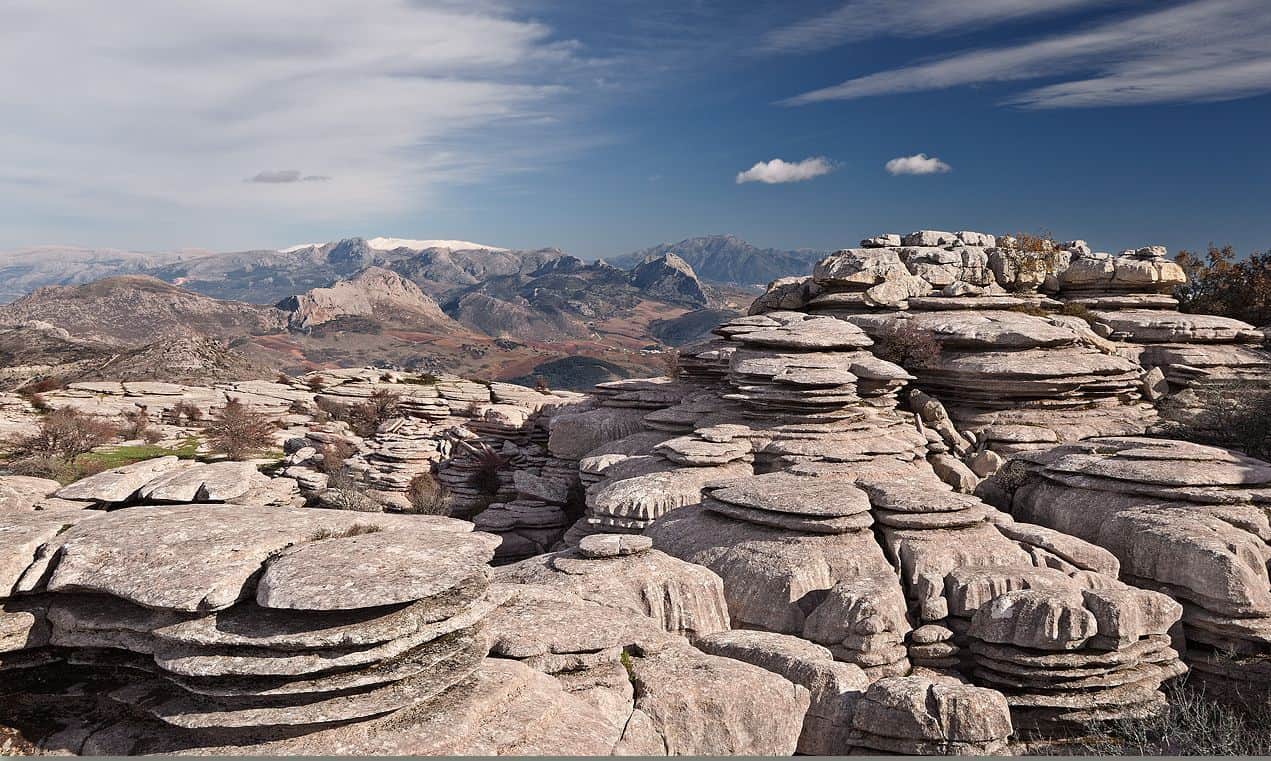
Explore stunning stone formations and mountain views with Costa Excursions’ guided tours.
Table of Contents
💧 Descend Into the Cliff at Ronda’s Water Mine
Most visitors to Ronda photograph the Puente Nuevo from a viewpoint and move on. Fewer know about the Casa del Rey Moro, a 14th-century building at the gorge’s edge that hides access to a staircase of 200+ steps carved directly into the cliff wall — a water mine built by Moorish engineers to guarantee access to the river below during sieges, when the town above was cut off. The descent is dark in sections, physically demanding on the way back up, and gives you a view of the gorge from inside the rock that almost no photograph of Ronda captures. Consistently the detail our guests mention most after a day in Ronda, and the one nobody expects.
🌉 Walk Beneath the Bridge You’d Otherwise Only Photograph From Above
For 250 years, the only way to experience Ronda’s famous bridge was from a viewpoint looking down. A new suspended walkway — the Desfiladero del Tajo, opened in phases starting in 2024 — changes that entirely: a path descending into the gorge itself, passing beneath the Puente Nuevo’s foundations through an original 18th-century tunnel built for the town’s water channels, with the bridge rising 98 metres directly overhead rather than below you. It’s short (30–45 minutes) and inexpensive, and it’s one of the few genuinely new things to experience in a town that’s been photographed the same way for two centuries.
🐒 Meet Europe’s Only Wild Monkey Population
Gibraltar’s Barbary macaques are the only wild primate population in Europe outside humans — around 300 of them, living freely on the Upper Rock of a British Overseas Territory 14 km from Africa. The genuinely unique part isn’t just the monkeys themselves, but the layering of the experience: a British colonial outpost, on Spanish soil, with a wild African primate population, connected to Spain by a border you cross on foot, with an airport runway that pedestrians and cars stop for when a plane needs to land. Very few destinations pack this many genuinely strange, specific details into one afternoon.
🏘️ Stand Inside a Village Built Into the Rock
Setenil de las Bodegas, 25 minutes from Ronda, takes the idea of “built into the landscape” further than almost anywhere else in Spain — entire streets where the ceiling is the overhanging cliff face itself, houses with a natural rock roof rather than a constructed one. It’s disorienting in the best way: you’re indoors and outdoors at the same time, standing under geology rather than architecture. Compact enough to see in 45 minutes, and unlike almost anything else on a typical Andalusia itinerary.
🍇 Taste Grape Varieties That Nearly Disappeared
Most wine tourism in Spain revolves around a handful of internationally recognisable grapes. A short drive from Ronda, one estate has spent over two decades doing the opposite — recovering native Andalusian varieties, some grown today in genuinely tiny quantities, that had nearly vanished from commercial production entirely. The wines carry names tied directly to local history: one is named for the 19th-century English Romantic travellers who first made Ronda famous internationally, another for a native Andalusian fish species now critically endangered. It’s a wine tasting built around preservation and specific regional history rather than a generic vineyard tour.
🕯️ Stand Beneath a Guinness World Record, 800,000 Years in the Making
The Nerja Caves, discovered by accident in 1959 by five teenage boys hunting bats, contain a 32-metre stone column — formed by a stalactite and stalagmite fusing together over roughly 800,000 years — that has held the Guinness World Record for the largest known formation of its kind since 1989. The same caves hold prehistoric paintings dated as far back as 25,000 BC, among the oldest documented cave art in Europe. The scale is genuinely difficult to process standing beneath it; most descriptions undersell it.
🥾 Walk a Path Once Called the World’s Most Dangerous
The Caminito del Rey, an hour from Málaga, was built in 1901 as a maintenance path for dam workers, fell into severe disrepair, and earned its notorious reputation after several fatal accidents led to its closure in 2000. Rebuilt to modern safety standards and reopened in 2015, it’s now completely secure — but the 7.7 km boardwalk, suspended up to 100 metres above the river in places, still delivers the genuine vertigo that made the original path famous, just without any of the actual danger.
🎭 See Pepe Illo’s Treatise Alongside Picasso and Goya
An unexpected pairing near Ronda: a private collection combining the historic Pepe Illo bullfighting treatise with original Picasso aquatints and Goya’s Bordeaux Bulls series — art and centuries-old Spanish cultural tradition in the same room, in a working wine estate rather than a formal museum. It’s the kind of specific cultural detail that doesn’t appear on standard sightseeing lists because it isn’t a public attraction — it’s part of a curated visit.
Why These Experiences Don’t Show Up on Generic “Best Of” Lists
Most “top things to do near Málaga” content recycles the same major landmarks — the Alhambra, the Alcazaba, the beaches — which are genuinely worth seeing but aren’t unique in the sense of being surprising or specific to this exact region. The experiences above share a common thread: they involve doing something physical and slightly unusual (descending into a cliff, walking beneath a bridge, standing under a geological record), or encountering something with a genuinely specific local story (a nearly-extinct grape variety, a village built into a cliff, a monkey population that shouldn’t exist in Europe at all). That specificity is what makes them memorable in a way that “visit the cathedral” rarely is, however worthwhile the cathedral genuinely is.
Experience these in person
Our private day trips from Málaga and Marbella include the water mine and gorge walkway in Ronda, Gibraltar’s monkeys, Setenil de las Bodegas, the Nerja Caves, the Caminito del Rey, and the native-grape wine tasting near Ronda. See all tours → or WhatsApp us at +34 651 026 027
Frequently Asked Questions
What are the most unique experiences near Málaga?
Descending 200 steps carved into the cliff at Ronda’s Casa del Rey Moro water mine, walking the new gorge-floor path beneath Ronda’s Puente Nuevo bridge, meeting Gibraltar’s wild Barbary macaques (Europe’s only wild monkey population), standing inside the cliff-built houses of Setenil de las Bodegas, and tasting native Andalusian grape varieties recovered from near-extinction at a winery outside Ronda.
What is the strangest thing to see near Málaga?
Setenil de las Bodegas is a strong candidate — an entire village where streets have a natural rock ceiling formed by an overhanging cliff, rather than constructed roofs. Gibraltar’s combination of British territory, wild African monkeys, and an airport runway crossing the main road is a close second.
Is the Nerja Caves column really a world record?
Yes — a 32-metre column formed by a fused stalactite and stalagmite in the Cataclysm Hall has held the Guinness World Record for the largest known formation of its kind since 1989.
What is the water mine in Ronda?
A staircase of 200+ steps carved into the gorge wall at the Casa del Rey Moro, built by Moorish engineers to secure water access from the river during sieges, when the town above was cut off. It’s one of the most distinctive and least-photographed experiences in Ronda.