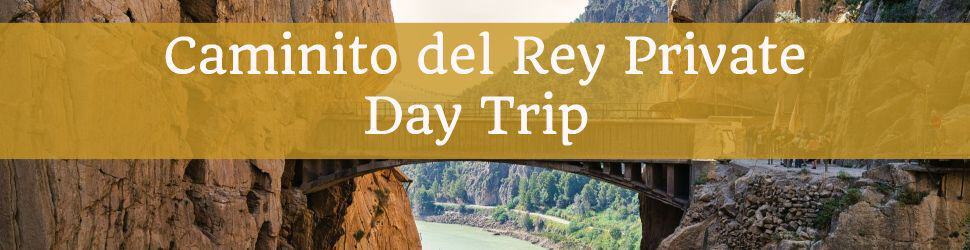
Every guest who’s done the Caminito del Rey with us says roughly the same thing afterward, in roughly the same tone of slight disbelief: they hadn’t expected it to be that dramatic. Photos of a boardwalk bolted to a cliff face don’t really translate the actual experience of standing on one, a hundred metres above a river, with a limestone gorge closing in on both sides. This guide covers what the trail actually involves, why a private tour changes the day compared to going independently, and everything you need to know before booking.
Table of Contents
What the Caminito del Rey Actually Is
The Caminito del Rey — “the King’s little path” — is a 7.7 km walkway through Los Gaitanes Gorge, about an hour from Málaga. It wasn’t built for tourists. Workers constructed the original path in 1901 to service two hydroelectric dams, giving maintenance crews a way to move along the gorge wall between the Chorro and Gaitanejo dams. King Alfonso XIII walked it in 1921 to formally open the dams, which is where the name comes from.
For most of the 20th century it was simply a working access route, not a destination. That changed when the concrete began to deteriorate and the path fell into serious disrepair — sections missing, railings gone, a hundred-metre drop with nothing between you and it. Climbers and adventure hikers discovered it anyway, photographs of the crumbling walkway went viral in the early 2000s, and it earned a reputation as one of the most dangerous paths in the world. Five people died on it between 1999 and 2000, and the regional government closed it entirely.
It stayed closed for over a decade. Then, between 2011 and 2015, the Málaga provincial government spent roughly €9 million rebuilding it to modern safety standards — a new boardwalk suspended above the original crumbling path, which is still visible below in places if you look for it. It reopened in 2015 and has been one of the most talked-about walks in southern Spain ever since.

Explore the stunning Caminito del Rey trail with breathtaking views and adventure.
What You’ll Actually See
The trail runs through two gorges — Gaitanejo and Los Gaitanes — connected by a reservoir, and it’s linear rather than a loop, so you finish at a different point than where you started. The full experience breaks into a few distinct sections.
The approach
The first stretch, from the northern entrance near Ardales, is relatively gentle — a dirt track through open countryside before the gorge begins to close in. Some visitors find this part slow to build up; it’s worth treating it as a warm-up rather than the main event.
The boardwalk through Los Gaitanes
This is what people come for. The gorge narrows to as little as 10 metres wide in places, with 300-metre limestone walls rising on either side, and the boardwalk clings to one of them at heights up to 100 metres above the river. The scale is genuinely difficult to photograph — you have to be standing there to understand it properly. The walkway itself is a metre wide with solid railings on the exposed side; it’s not dangerous, but it doesn’t feel entirely safe either, which is more or less the point.
The original path, still visible
In several sections, the crumbling 1901 concrete original is visible just below the new boardwalk — missing chunks, exposed rebar, no railing at all. Seeing it directly beneath your feet gives the “world’s most dangerous path” reputation a context that’s hard to get any other way. It’s one thing to read that people died here; it’s another to look down and see exactly the kind of structure that made it happen.
The final stretch
After the gorge, the trail opens back out around the Conde del Guadalhorce reservoir before reaching the southern exit at El Chorro. This section is pleasant rather than dramatic — most of what people remember happens in the gorge itself.

Experience the breathtaking Caminito del Rey trail with stunning canyon views in Malaga, Spain.
How Long It Takes and What It Demands
Budget 3–4 hours for the full 7.7 km at a comfortable pace, including stops for photos — faster walkers manage it in 2.5. It’s not technically difficult; the elevation gain is gentle and there’s no climbing involved. The real challenge is psychological rather than physical. If you have a genuine fear of heights, the exposure on the boardwalk sections is unavoidable and won’t get easier the further you go. Most people who describe themselves as “a bit nervous about heights” do fine once they’re moving; people with a serious phobia generally know in advance that this isn’t for them.
Physically, you need to be able to walk close to 8 km on a mix of boardwalk and some uneven natural terrain, including narrow sections and occasional steps. It’s not accessible for wheelchairs, and children under 8 aren’t permitted — a rule that’s enforced at the entrance, not a suggestion.
Why a Private Tour Changes the Day
Independent visitors run into the same three problems, over and over: tickets sell out weeks or months ahead in peak season and are easy to miss if you’re not watching closely; the trail is linear, which means you finish at a different car park than you started at, and getting back to your vehicle involves a shuttle bus with its own timing to work around; and public transport options from Málaga are limited enough that most independent visitors end up driving anyway, then dealing with parking that fills early on busy days.
We handle all three. Tickets are booked as part of your tour, from a separate allocation that sometimes has availability even when the public booking system shows nothing. We pick you up at your hotel in Málaga or Marbella, drop you at the northern entrance, and meet you at the southern exit — no shuttle bus, no walking back to a car park at the end of an already tiring walk. And because we’ve been doing this since 2008, we know exactly how the entry timing windows work and plan the pickup accordingly, rather than you guessing.
There’s also a simpler advantage that’s easy to underestimate: someone who’s done this walk hundreds of times knows which sections are worth slowing down for, where the original 1901 path is most visible, and how to time the day so you’re not rushing the last stretch to catch a shuttle. It changes the walk from “an activity you completed” into a day you actually enjoyed.

A hiker crosses a transparent glass walkway suspended over a scenic canyon in Malaga.
Booking Tickets — The Part Most People Get Wrong
Tickets cost €180 per person on the official site and must be booked in advance — there’s no walk-in option, full stop. In spring and autumn especially, dates sell out 6–8 weeks ahead, sometimes faster around long weekends. Summer is slightly more forgiving since the heat puts some visitors off, but tickets still go. Winter is the easiest season for last-minute availability, though the trail also closes for maintenance for most of January, so check dates carefully if you’re planning a winter visit.
If you’ve already tried the public system and found nothing for your dates, it’s worth contacting us before giving up entirely — our operator allocation is managed separately and has come through for guests more than once when the public site showed nothing.
Getting There — Distance and Logistics
The Caminito del Rey sits about 60 km northwest of Málaga, roughly an hour by car via the A-357 toward Campillos, then the MA-444 to Ardales. From Marbella it’s closer to 90 km, about 1 hour 20. There’s a car park at the northern entrance near Ardales that fills quickly on busy days, and a shuttle bus (included in your ticket) that returns visitors from the southern exit at El Chorro back to the start.
A Cercanías train also runs from Málaga to El Chorro village, which is the southern exit rather than the entrance — meaning independent train travellers arrive at the wrong end and need to arrange a shuttle to the actual starting point before they’ve even begun. It’s workable, but adds a layer of complexity that most visitors don’t anticipate.

A stunning view of a narrow bridge built along a steep mountain cliff in Spain, offering breathtaking scenery.
What to Wear and Bring
- Closed-toe shoes with real grip — sandals and flip-flops are refused at the entrance, not just discouraged
- A small backpack rather than anything carried by hand, since your hands need to be free on some sections
- At least 1.5 litres of water per person — there’s nowhere to buy any along the trail itself
- Sun protection for the exposed approach and exit sections, which have little shade
- A helmet — provided free at the entrance and mandatory throughout
Combining Caminito del Rey with Other Destinations
Most guests treat this as a morning activity and are back at their hotel by early-to-mid afternoon, which leaves room to pair it with something else if you want a fuller day. Ardales village itself, five minutes from the northern entrance, has a good local tapas bar and is worth a stop for lunch. For guests with more time, Ronda is about 45 minutes from El Chorro — doable as a combined day if you finish the trail by early afternoon, though it makes for a genuinely long day rather than a relaxed one.

Tourists enjoying a guided private day trip exploring the stunning narrow canyon in Malaga.
Who This Is and Isn’t For
It’s a strong match for active travellers, anyone who wants one dramatic, physical experience during their trip rather than another sightseeing walk, and families with children 8 and up who are comfortable with heights. It’s not the right choice for young children, anyone with significant mobility limitations, or genuinely severe acrophobia — no version of the day works around those constraints, and we’d rather tell you that honestly than sell you a tour that won’t suit you.
A specific note for anyone unsure which side of that line they fall on: mild nervousness about heights is genuinely common among people who end up loving this walk. The boardwalk railings are solid, the path itself never feels unstable underfoot, and most people find that the anxiety of the first few hundred metres fades once they realise the structure is completely trustworthy. What doesn’t fade, and shouldn’t be pushed through, is a diagnosed phobia or a strong physical reaction to exposure — vertigo, genuine panic, that kind of response. If that describes you, this specific walk isn’t the place to test it.
What Guests Actually Say Afterward
The reaction we hear most often isn’t about the views, though those are genuinely spectacular — it’s a kind of surprise at how physically present the experience is. Photographs flatten the scale of the gorge; standing on the boardwalk doesn’t. Several guests have told us it was the single thing from their whole Spain trip they talked about most once they got home, more than the beach, more than tapas, more than the cathedrals. That’s not something we can promise will happen for everyone, but it’s a pattern consistent enough across hundreds of tours since 2008 that we think it’s worth mentioning honestly rather than as a marketing line.
The other thing that comes up often: relief that the tickets and logistics were handled. Several guests have specifically mentioned they’d tried to book independently first, hit the sold-out message on the official site, and only found out about our operator allocation after searching for alternatives. It’s a genuinely common story, which is part of why we mention ticket availability so directly in this guide rather than assuming everyone already knows how competitive it can get.
Book the Caminito del Rey without the ticket stress
Hotel pickup from Málaga or Marbella, tickets included, and a driver who meets you at the exit instead of a shuttle bus. See tour details → · from €450/group · WhatsApp us at +34 651 026 027
Frequently Asked Questions
Is the Caminito del Rey safe?
Yes, entirely — the 2011–2015 rebuild replaced the crumbling original path with a modern, secure boardwalk with solid railings throughout. The “world’s most dangerous path” reputation refers to the deteriorated pre-2000 version, not the current structure. That said, the exposure and height are genuinely real and not for everyone psychologically, even though it’s physically safe.
How much does the Caminito del Rey cost?
€18 per person for the official entry ticket. A private tour including hotel pickup, tickets, and transport back from the exit point starts from €450 per group (not per person).
Do I need to book Caminito del Rey tickets in advance?
Yes, always — there’s no walk-in option under any circumstances. In peak season (spring and autumn), tickets often sell out 6–8 weeks ahead. Winter is generally easier for last-minute booking, though the trail closes for most of January for maintenance.
Can children do the Caminito del Rey?
Children aged 8 and over are permitted; under 8 is not allowed, and this is enforced at the entrance. Beyond the age minimum, it depends on the individual child’s comfort with heights and ability to walk roughly 8 km.
How do I get back to my car after finishing the Caminito del Rey?
The trail is linear, finishing at a different point (El Chorro) than where it starts (near Ardales). A shuttle bus, included in your ticket, returns independent visitors to the starting car park. On our private tours, we simply meet you at the exit directly, so there’s no shuttle wait involved.