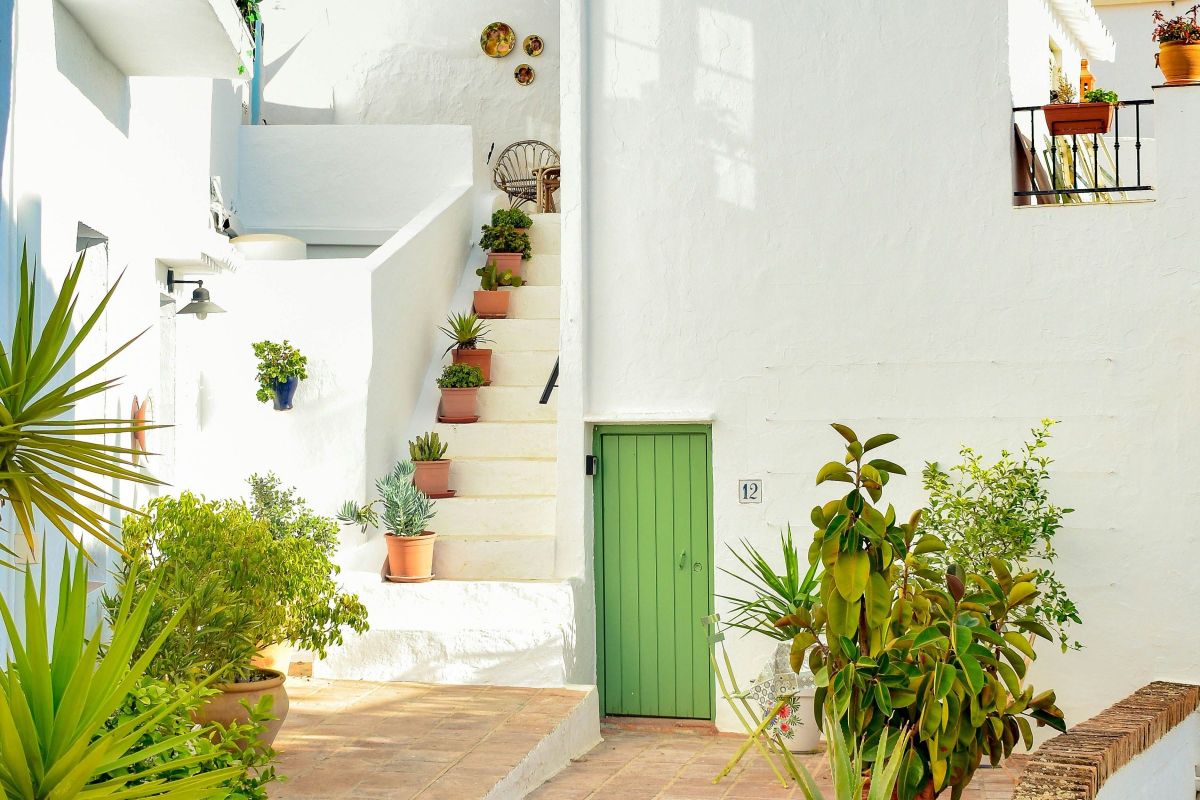
Frigiliana is 6 km from Nerja, 61 km from Málaga, and consistently voted one of the most beautiful villages in Spain. It has a Moorish quarter that survived the Reconquista more or less intact, ceramic tile murals built into the walls that tell the story of a 16th-century revolt, views from the upper village over the Axarquía hills to the sea, and the best miel de caña (sugarcane molasses) in mainland Spain. Here’s everything worth knowing before you go.
🎯 Quick Facts
- Distance from Málaga: 61 km — approximately 55 minutes by car
- Distance from Nerja: 6 km — 10 minutes by car, 2 hours on foot (steep)
- Distance from Marbella: 126 km — approximately 1 hour 35 minutes
- Best time: April–June and September–October
- Parking: Free car park at the village entrance — don’t try to drive into the Barrio Alto
- Time needed: 1.5–2.5 hours to see it properly
⚡ TL;DR
Frigiliana is the best white village within an hour of Málaga — compact, genuinely Moorish in character, and less visited than Mijas despite being consistently rated higher. The Barrio Alto is the reason to go: 10 ceramic tile murals telling the story of the 1569 Moorish revolt, whitewashed lanes too narrow for cars, flower-draped balconies, and views to the sea. Most people combine it with Nerja and the Nerja Caves on the same day.
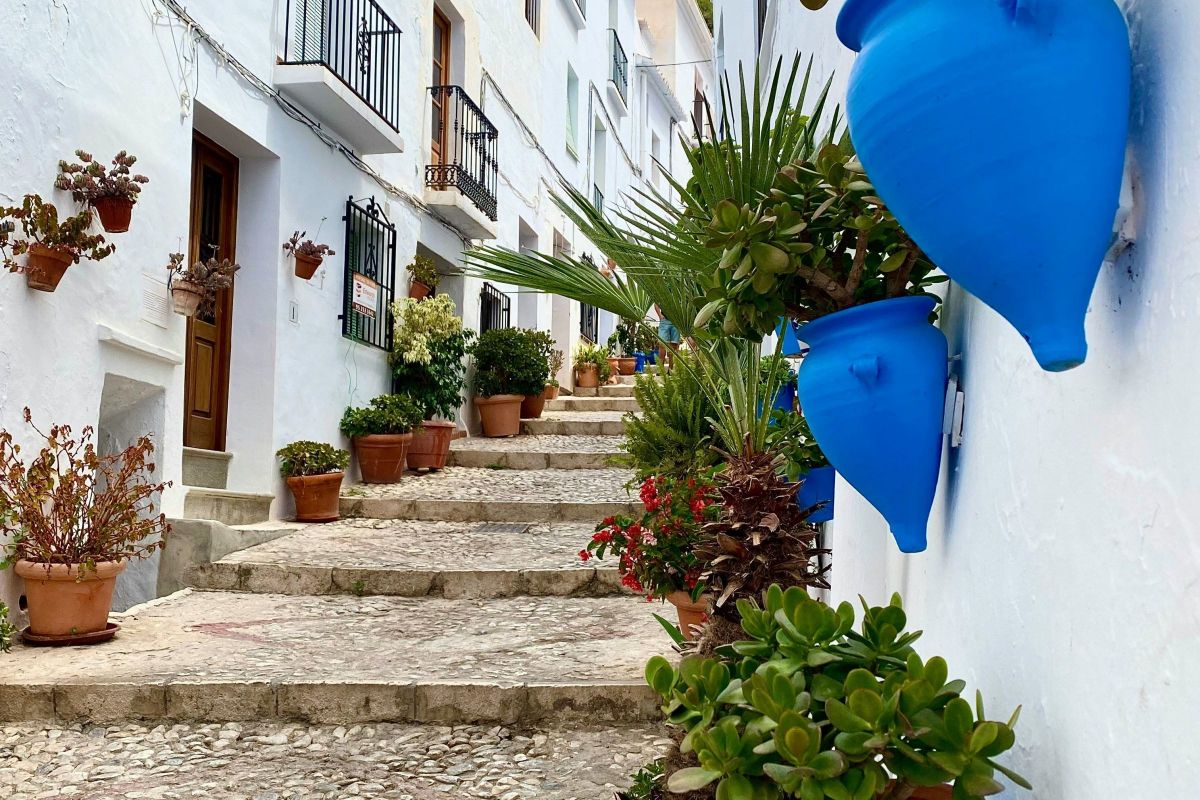
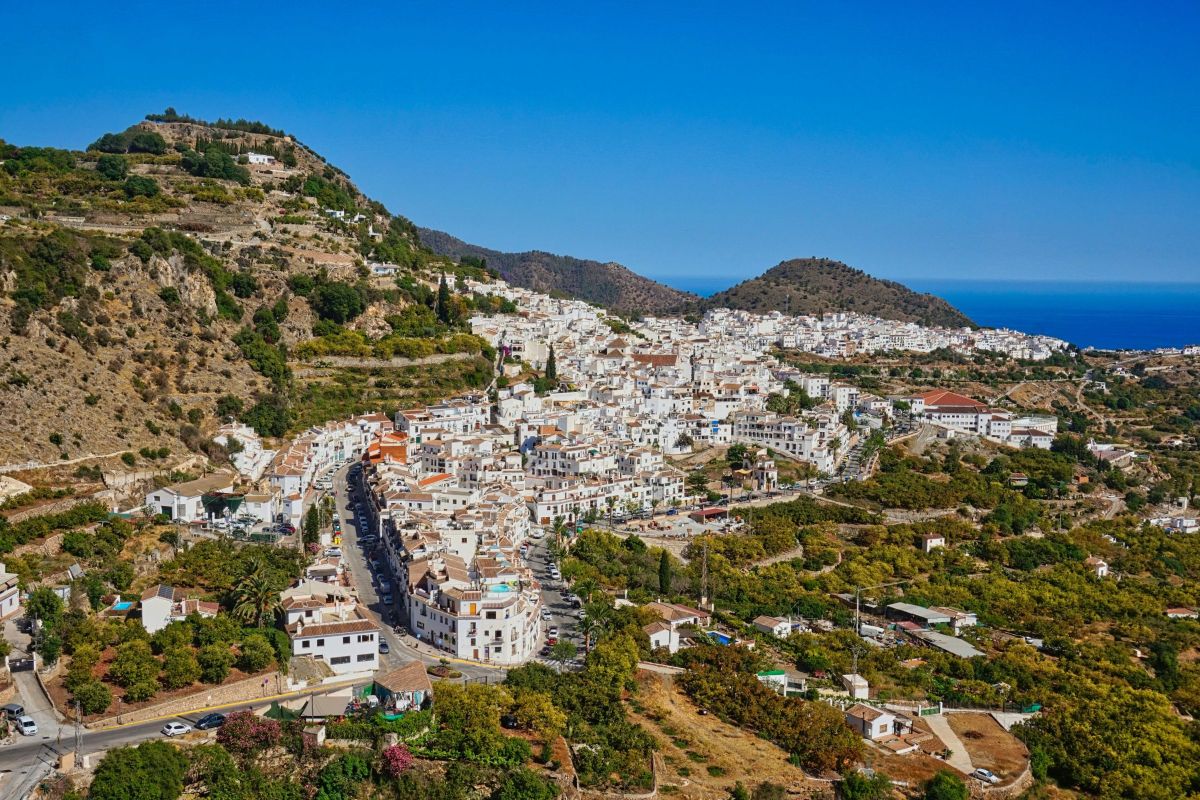
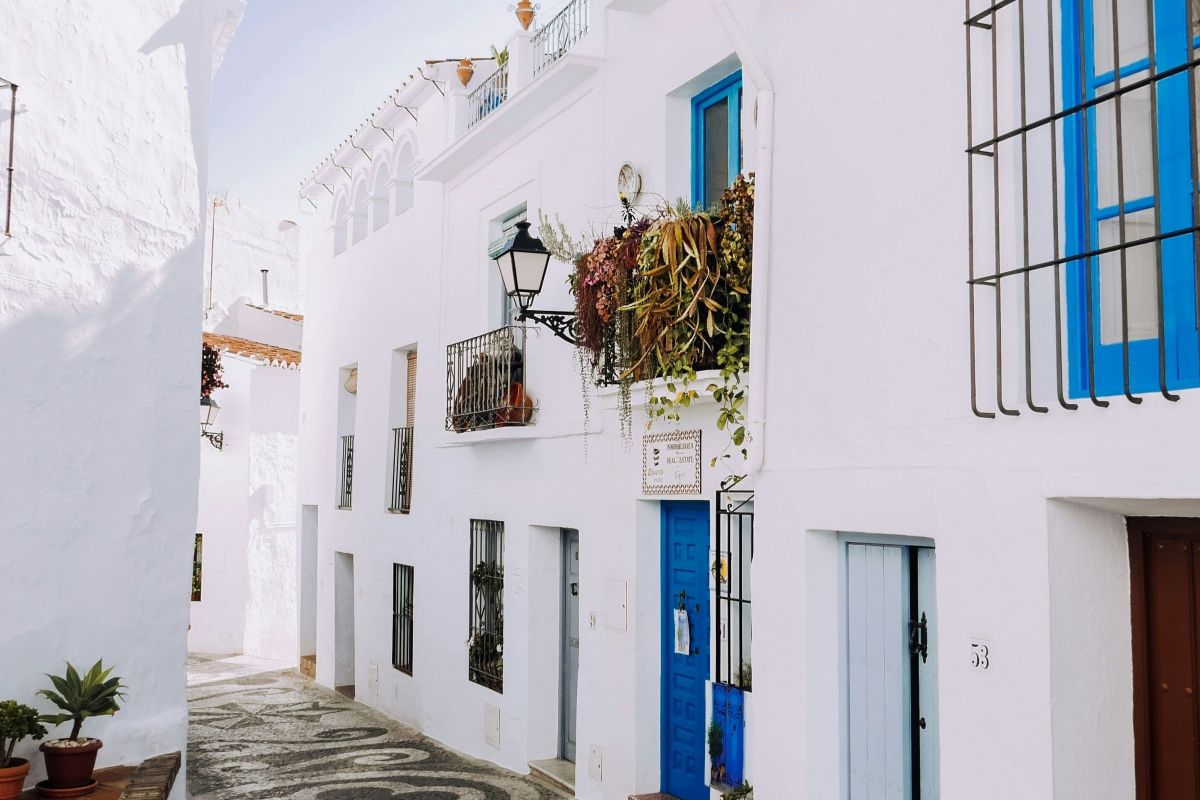
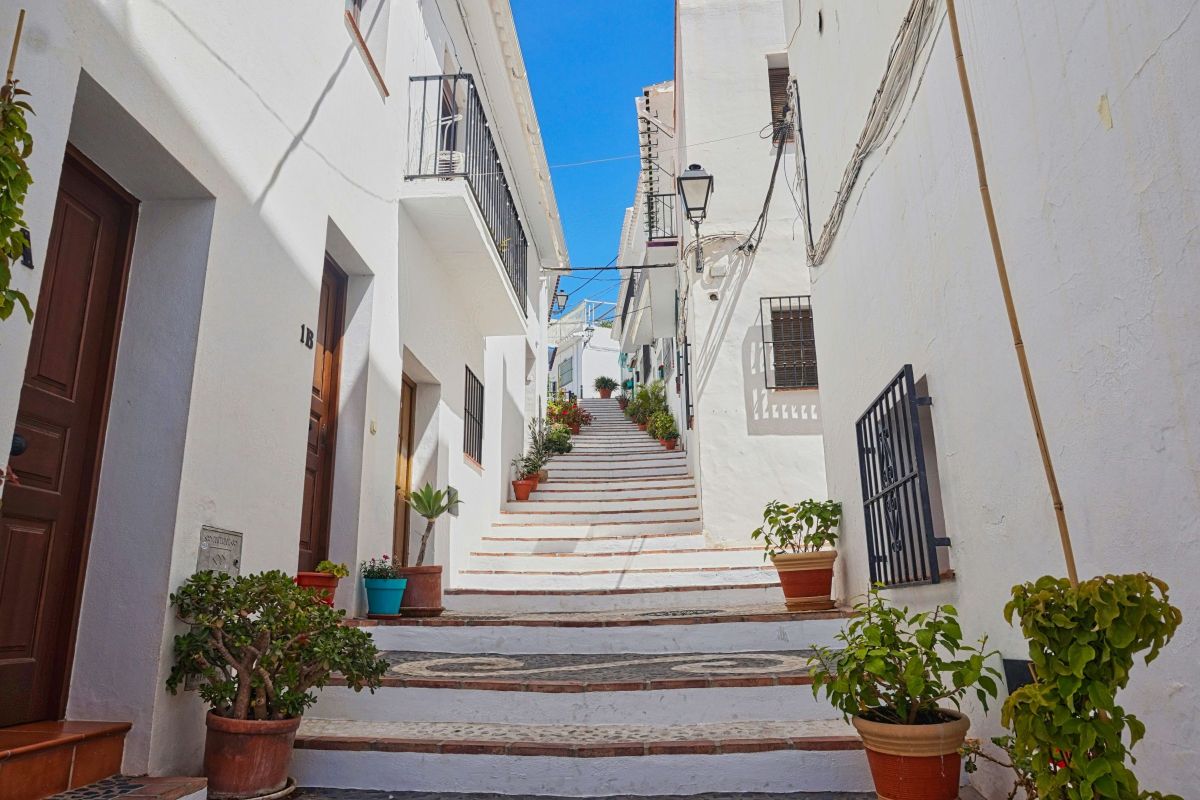
Frigiliana sits at 300 metres in the first foothills of the Sierra de Almijara, directly above Nerja. The lower part of the village — built in the 20th century — is functional and unremarkable. The upper part, the Barrio Alto, is what the photographs show and what the awards are for. A Moorish medina layout that has remained largely unchanged since the 16th century: lanes 1.5 metres wide, whitewashed walls, terracotta pots, flowering balconies, and ten hand-painted ceramic tile murals set into the walls telling the history of the town.
It was named Spain’s most beautiful village in 2016 and has appeared in multiple “best of” lists since. The recognition is deserved. It’s also still genuinely a village rather than a theme park — people live in these houses, wash hangs from the balconies, and the cats sunbathing on the warm white walls are not placed there for tourism.
Table of Contents
The History — Why Frigiliana Looks the Way It Does
Understanding Frigiliana requires understanding what happened in 1569. After the Reconquista finally ended in 1492 with the fall of Granada, the Muslim population of Andalusia was ordered to convert to Christianity. Those who converted became moriscos — nominally Christian but culturally and linguistically Moorish. For 70 years they maintained their language, dress, customs, and Islamic practice in private while performing Christian observance publicly.
In 1568, Philip II issued a decree banning Arabic language, Moorish dress, Arabic names, and Moorish cultural practices entirely. The result was a revolt across the Alpujarras and the Axarquía — the Second Rebellion of the Alpujarras. In Frigiliana, the moriscos took refuge on the Peñón de Frigiliana — the rocky outcrop above the village — along with hundreds of others from surrounding towns. The Spanish forces surrounded them. After several weeks, the Peñón fell. The slaughter was significant. The survivors were expelled from the region.
The ten ceramic tile murals in the Barrio Alto tell this story — in Arabic calligraphy alongside Spanish text, with illustrations of the uprising, the siege, and the aftermath. They were commissioned in the 1980s as a form of historical commemoration. They’re set into the walls of the Barrio Alto at regular intervals so you encounter them as you walk the lanes — not in a museum, but in the streets where the events happened.
The village’s Moorish character survived because after the expulsion, the whitewashed houses, the narrow lanes, and the terraced hillside layout remained. New settlers arrived but built within the existing framework. The result is a Moorish urban structure that has been continuously inhabited for 500 years.
What to See in Frigiliana
🏘️ The Barrio Alto
The upper Moorish quarter is the reason people come. From the car park at the village entrance, follow the signs uphill into the old quarter — Calle Real is the main route in. The lanes narrow quickly. Within 5 minutes you’re in streets too narrow for a car, with walls close enough to touch on both sides and the faint smell of jasmine from the balconies above.
Walk without a fixed route. The Barrio Alto is small enough (roughly 400 metres across) that you can’t get seriously lost, and the best encounters — a particularly good mural, a doorway opening onto an interior courtyard, a cat on a wall with the sea visible behind it — happen when you stop following a plan.
The lanes are steep in places. Flat shoes with some grip are advisable. Sandals work in summer but flip-flops are not ideal on uneven cobblestones.
🎨 The Ceramic Tile Murals
Ten murals, set into the walls of the Barrio Alto at intervals along the route. Each one depicts a scene from the 1569 revolt — the uprising, the retreat to the Peñón, the siege, the final battle. The text is in both Arabic and Spanish. The ceramic tile work is high quality — these are not tourist decorations but a serious historical commission.
Take your time with them. The Arabic calligraphy is readable to anyone who knows the script, and the illustrations are detailed enough to tell the story without translation. Each mural has a number — try to find all ten.
🌄 The Views
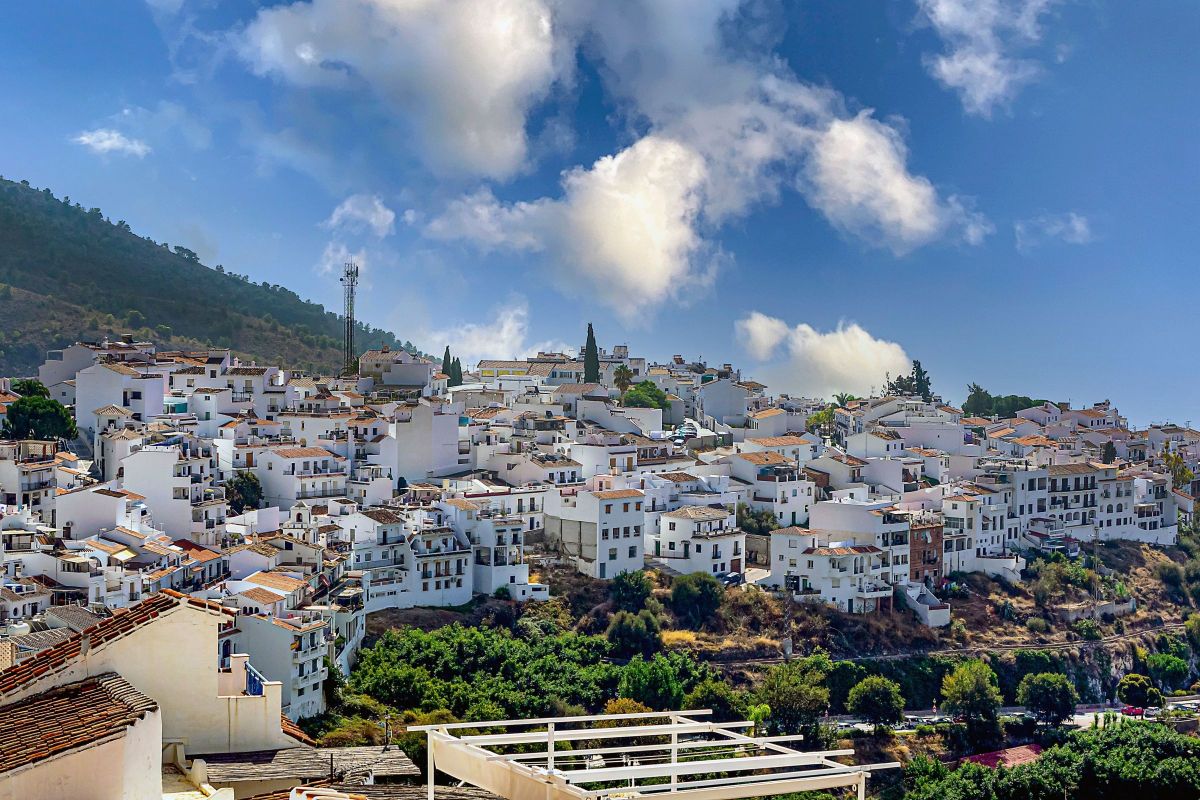
From the upper parts of the Barrio Alto — particularly the small mirador near the church at the top — the views are south over the lower village and the coastal plain to the Mediterranean, east and west across the Axarquía hills, and north into the Sierra de Almijara. On a clear day, Africa is a smudge on the horizon to the south.
The sea appears closer than it is — you’re only 6 km from Nerja but at 300 metres altitude the distance feels compressed. The combination of mountain air, terracotta rooftops, whitewashed walls, and sea in the background is the image that appears in every travel photograph of Frigiliana.
🍯 Miel de Caña — The Local Product
Miel de caña is sugarcane molasses — a thick, dark, intensely sweet syrup produced from sugarcane that has been grown in the Axarquía since Moorish times. Frigiliana is one of the last places in mainland Europe where sugarcane is still commercially processed. The local factory, Ingenio San Francisco, has been operating since 1937 and produces the molasses that is sold in every shop in the village.
It tastes nothing like honey despite the name (miel means honey). It’s closer to treacle — dark, rich, slightly bitter underneath the sweetness. It’s used in baking, drizzled on bread, mixed into yoghurt, and eaten with cheese. It’s genuinely unique to this area and worth taking home. Available in the local shops in small jars from approximately €3–5.
🛍️ The Shops
The craft shops in the Barrio Alto are consistently above the level of generic souvenir tat. Ceramics, leather goods, handmade jewellery, olive wood products, and the miel de caña in various forms. The ceramic tile reproductions of the historical murals are the most popular souvenir — small versions of the wall murals, properly made rather than mass-produced. Prices are reasonable for handmade work.
🍽️ Where to Eat in Frigiliana
Frigiliana has a handful of genuinely good small restaurants — better than you might expect for a village of 3,000 people. The combination of day-tripper demand and a quality-conscious local food culture has produced some real options:
- El Jardín de las Eras — terrace restaurant at the top of the Barrio Alto, good views, solid Andalusian food. The gazpacho and the grilled fish are reliable. Busier in summer — arrive early for lunch or book ahead.
- La Bodeguilla de Frigiliana — wine bar and tapas in the lower village. Good local wines, simple food done well. Less touristy than the terrace restaurants.
- Restaurant Jardín Tropical — mid-range, good for groups, garden seating. Reliable rather than exceptional.
- The village bakery on Calle Real — buy miel de caña on fresh bread here. Simple, local, worth stopping for.
Most people do lunch in Frigiliana after the Nerja Caves and Nerja town. Arriving at 1:30–2:00 PM means the best tables are still available. After 2:30 PM in summer, wait times increase significantly.
How to Get to Frigiliana
By car from Málaga
61 km via the A-7 east toward Nerja, then turn inland on the MA-5105 toward Frigiliana. Approximately 55 minutes. Free car park at the entrance to the village — don’t attempt to drive into the Barrio Alto. The lanes are physically impassable by car and most are pedestrian-only.
By car from Marbella
126 km via the A-7, approximately 1 hour 35 minutes. Most visitors from Marbella combine Frigiliana with the Nerja Caves and spend a full day — see our Nerja and Frigiliana private day trip.
From Nerja
6 km, 10 minutes by car or taxi (approximately €10). There is a local bus service but it runs on a limited schedule — check times before relying on it. Walking is possible but involves a steep uphill climb of about 2 hours — fine as a descent, tiring as an ascent.
By private tour from Málaga or Marbella
Most visitors combine Frigiliana with the Nerja Caves and Nerja town in a single day. We run private day trips from Málaga and Marbella that cover all three — Nerja Caves (tickets included), Balcón de Europa, and Frigiliana — with door-to-door hotel pickup. From €600/group.
Private Nerja & Frigiliana Day Trip → · From €600/group · Nerja Caves tickets included · Hotel pickup from Málaga or Marbella · WhatsApp +34 651 026 027
Best Time to Visit Frigiliana
Frigiliana works year-round but some months are clearly better than others:
- April–June: the flowers on the balconies are at their peak — the geraniums, bougainvillea, and jasmine that define the village’s visual character are fullest in spring. Temperatures comfortable (18–26°C). Not overcrowded. The best overall months.
- September–October: harvest season in the Axarquía — grapes, avocados, mangoes. The countryside around Frigiliana is at its richest. Temperatures still warm (22–28°C). Fewer visitors than summer.
- July–August: hot (28–32°C at the coast, warmer inland), busy. The Barrio Alto can feel crowded on summer weekends. Arrive before 10 AM or after 4 PM to avoid the peak. The village is still beautiful — just busier.
- November–March: very quiet, cool (12–17°C), the flowers are thinner but the light is cleaner and sharper. The village is essentially locals-only in January. Good for photography. Some restaurants have reduced hours or close midweek.
The Feria de Frigiliana in late August (usually the last week) is worth mentioning — three days of flamenco, music, food stalls, and the village at its most festive. Accommodation nearby sells out. If you’re staying on the coast during that week, a day trip to the feria is a good use of an evening.
Combining Frigiliana with Nerja
Frigiliana and Nerja are 6 km apart and most visitors do both in a single day. The natural order:
- Morning: Nerja Caves (quieter before 11 AM, cooler in the cave)
- Late morning: Nerja town — Balcón de Europa, old streets, coffee
- Afternoon: Frigiliana — Barrio Alto, murals, lunch, views, shops
- Return: drive back to Málaga or Marbella
Total time from Málaga: 6–7 hours. From Marbella: 7–8 hours. A full but not exhausting day. See our complete Nerja and Frigiliana day trip guide for the full planning breakdown.
Frequently Asked Questions
Is Frigiliana worth visiting?
Yes — consistently. It has one of the best-preserved Moorish quarters in Andalusia, genuine historical depth (the 1569 revolt murals are serious historical work, not tourist decoration), views to the sea, and a local food product unique to mainland Spain. It’s small enough to see properly in 1.5–2.5 hours and different enough from the coast to justify the short detour from Nerja.
How far is Frigiliana from Málaga?
61 km — approximately 55 minutes by car via the A-7 east toward Nerja and then inland. From Marbella it’s 126 km and approximately 1 hour 35 minutes. From Nerja it’s 6 km — 10 minutes by car.
What is Frigiliana famous for?
Three things: the Barrio Alto (one of the best-preserved Moorish urban quarters in Andalusia), the ten ceramic tile murals depicting the 1569 Morisco revolt that are built into the walls of the old quarter, and miel de caña — sugarcane molasses produced locally at a factory that has been operating since 1937. Frigiliana is one of the last places in mainland Europe where sugarcane is still commercially processed.
Can I drive into Frigiliana old town?
No — the Barrio Alto lanes are physically too narrow for cars and are pedestrian-only. There is a free car park at the village entrance. Park there and walk up into the old quarter on foot. The walk from the car park to the top of the Barrio Alto takes about 20–25 minutes uphill.
How long do you need in Frigiliana?
1.5 to 2.5 hours to see the Barrio Alto properly — the murals, the views, a browse of the shops, and lunch if you’re eating there. Most visitors combine it with Nerja and the Nerja Caves on the same day, which makes for a complete 6–7 hour day from Málaga.
What is miel de caña?
Miel de caña is sugarcane molasses — a thick, dark, intensely sweet syrup produced from sugarcane grown in the Axarquía. Despite the name (miel means honey), it has no honey in it — it’s made exclusively from sugarcane juice. Frigiliana is one of the last places in mainland Europe where sugarcane is still commercially produced. The local factory has been operating since 1937. Available in every shop in the village from approximately €3–5 per jar.
What are the ceramic tile murals in Frigiliana?
Ten ceramic tile murals set into the walls of the Barrio Alto, depicting the 1569 Second Rebellion of the Alpujarras — when the morisco population (Moorish converts to Christianity) of Frigiliana and surrounding towns revolted against Philip II’s decree banning Arabic language and Moorish cultural practices. The murals were commissioned in the 1980s and include text in both Arabic and Spanish. They are historical commemorations, not tourist decorations, and give the village its distinctive character.
Is Frigiliana better than Mijas?
Different rather than better. Mijas is closer to Málaga and Marbella (30 km vs 61 km), works as a half-day trip, and has the square bullring and burro taxis. Frigiliana is further, has deeper historical character, better views, and the miel de caña and mural trail. If you have time for both, do both — they’re genuinely different experiences. If you’re choosing one: Mijas for convenience, Frigiliana for character.
Final Thoughts
Frigiliana is the most historically interesting white village within an hour of Málaga — the Moorish quarter, the revolt murals, and the sugarcane molasses are all genuinely specific to this place. Most visitors combine it with Nerja and the Nerja Caves on the same day, which makes for a full and varied day from the coast. If you want private transport from Málaga or Marbella with Nerja Caves tickets included, see our Nerja and Frigiliana private day trip → or WhatsApp us at +34 651 026 027.