One day in Ronda is enough — if you use it well. The town is compact, the main sights are within 20 minutes’ walk of each other, and 6 hours on the ground covers everything worth seeing. The mistake most visitors make is spending too long at the Puente Nuevo viewpoint and not enough time in the old town and the gorge itself. This itinerary fixes that.
🎯 Key Takeaways
- Start at the gorge viewpoints first — before the coach groups arrive around 11 AM.
- Casa del Rey Moro water mine (€8) is the most underrated sight — 200 steps into the gorge wall. Do not skip it.
- Bono Turístico (€12) covers 5 sites — worth it if you’re going inside the bullring, Arab Baths, and Mondragón Palace.
- Have lunch late — 2 PM rather than 1 PM means restaurants are less crowded and the afternoon is cooler for walking.
- From Málaga: 100 km / 1h 20. From Marbella: 65 km / 1h. Both easily done as a day trip.
⚡ TL;DR
9:30 AM Mirador de Aldehuela (gorge view) → 10:00 AM cross Puente Nuevo into old town → 10:15 AM Casa del Rey Moro water mine → 11:30 AM Arab Baths and Mondragón Palace → 12:30 PM Plaza de Toros (oldest bullring in Spain) → 1:30 PM Jardines de Cuenca (best bridge photo) → 2:00 PM lunch → 3:30 PM Carrera Espinel shopping / free time → 5:00 PM depart. That’s one day in Ronda done properly.
Ronda divides neatly into two parts separated by the Puente Nuevo bridge: the new town (El Mercadillo) to the north, and the old town (La Ciudad) to the south. Almost everything worth seeing is in or immediately around the bridge and the old town. The new town has the train station, most of the hotels, the main shopping street, and the viewpoint — but that’s about it for tourists.
The itinerary below assumes you arrive at 9:00–9:30 AM (the right time to arrive, before the coaches) and depart at 5:00–5:30 PM. It works whether you’re coming from Málaga (100 km, 1h 20) or Marbella (65 km, 1h). It covers everything significant without rushing.
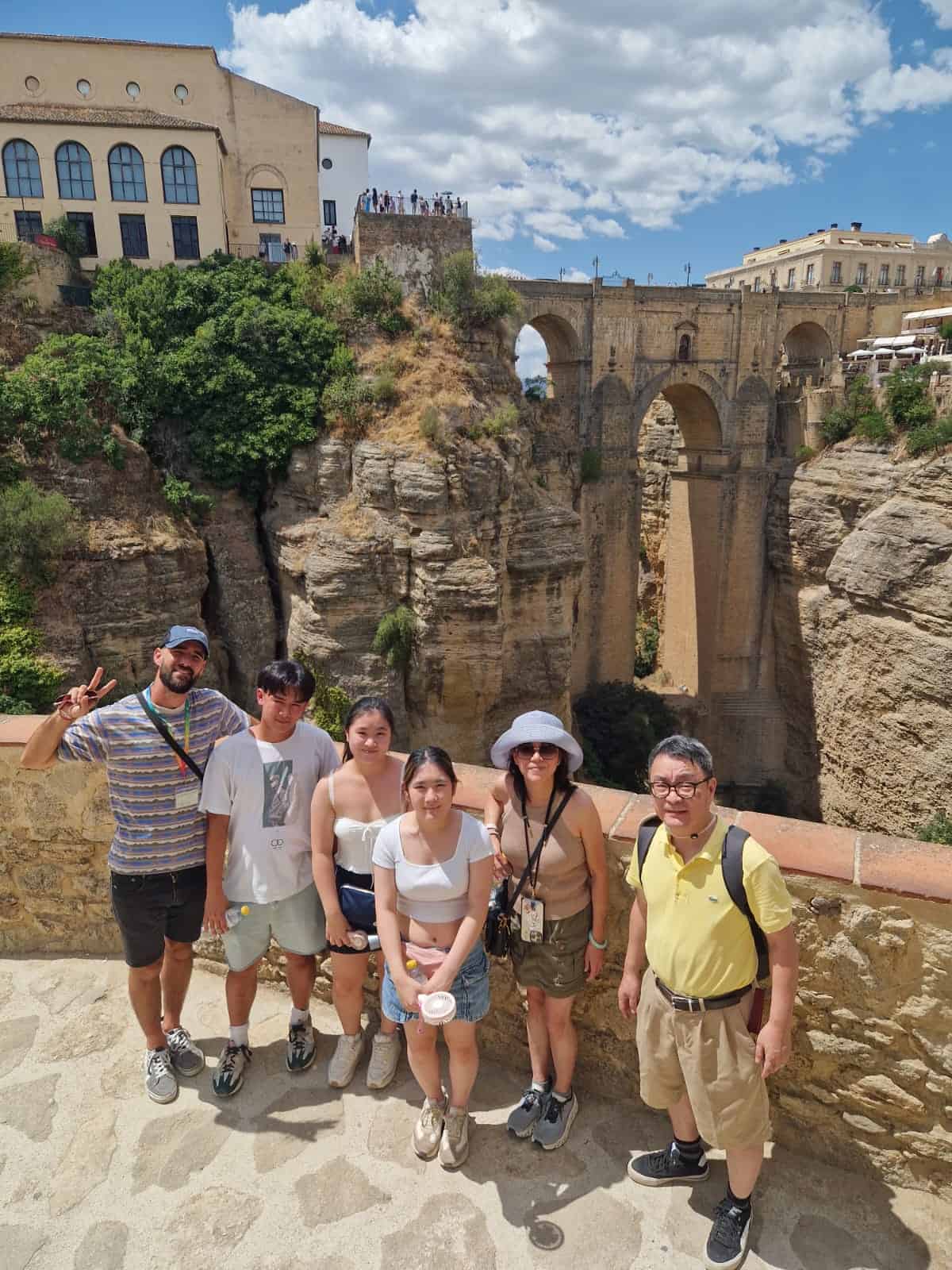
Group of tourists visiting the iconic Puente Nuevo bridge in Ronda, enjoying scenic views and photo opportunities.
Table of Contents
The Full One-Day Ronda Itinerary
9:00–9:30 AM — Arrive and Head Straight to the Viewpoints
The Puente Nuevo viewpoints are the most photographed spots in Ronda. The reason to go early is simple: by 11 AM there are coaches parked below and 20–30 people queued at each viewpoint. At 9:30 AM you may have them almost to yourself.
There are two essential viewpoints:
- Mirador de Aldehuela — on the new town side, 5 minutes from the main car parks. Gives the head-on view of the bridge with the gorge below. This is the standard Ronda postcard shot. Free, no entry required, open access.
- Jardines de Cuenca — on the old town side, accessible via Calle Marqués de Salvatierra. Gives the lateral view from slightly below — the bridge in profile with the gorge walls and the river visible. The better photograph, in most people’s opinion. Also free. You’ll come back here in the afternoon for the light.
Budget 30–40 minutes for both viewpoints at an unhurried pace. Walk across the bridge between them — it’s free and the view directly down into the gorge is different from the side viewpoints.
9:45–10:00 AM — Cross into the Old Town
Cross the Puente Nuevo heading south — you’re now in La Ciudad, the old Moorish quarter of Ronda. The old town sits on a flat-topped plateau with the gorge on three sides. The streets are whitewashed, mostly pedestrianised, and almost entirely free of the souvenir shops that cluster around the bridge on the new town side.
Head immediately down Calle Armiñán (the main street running south from the bridge) toward the Casa del Rey Moro. Don’t linger on Calle Armiñán itself — save the old town exploration for after the water mine.
10:00–11:00 AM — Casa del Rey Moro and the Water Mine
This is the most underrated sight in Ronda and the one most visitors skip because the description doesn’t convey what it actually is.
The Casa del Rey Moro (€8) is a 14th-century Moorish palace at the very edge of the gorge — access to the gardens and, more importantly, the mina de agua (water mine) is through here. The water mine is a staircase carved into the inside of the gorge wall, descending 200+ steps from the palace level to the river below. It was built in the 14th century to guarantee water supply during sieges — a secret exit that could reach the river even if the town was surrounded.
What you get: a narrow stone staircase cut into the cliff, descending 80 metres with the gorge wall on one side and open air on the other. The views change at every level. At the bottom the river is close enough to touch. Then you climb back up. The ascent takes about 20 minutes and is aerobic. Bring water.
The house above the mine was owned in the 19th century by the Duke and Duchess of Parcent, who created the formal gardens that now surround it. The gardens are accessible from the entrance and worth 10 minutes on the way back up.
Budget 45–60 minutes total. The mine is dark in sections — the entrance provides basic torches if needed.
11:00 AM–12:00 PM — Old Town: Arab Baths, Mondragón Palace, and the Medieval Streets
After the water mine, you’re already in the old town. This hour covers the remaining historical sites at a relaxed pace.
Arab Baths (Baños Árabes) — €4
13th-century Hammam baths — one of the best-preserved sets of Arab baths in Andalusia. Three interconnected rooms (cold, warm, and hot) with star-shaped skylights in the vaulted ceilings — the light effect at certain times of day is the reason to visit. 15–20 minutes.
Mondragón Palace (Palacio de Mondragón) — €4
14th-century Nasrid palace — the former residence of the Moorish kings of Ronda, later converted by the Christian conquerors. Interior courtyard with Moorish tilework, Mudéjar arches, and a municipal museum covering the prehistory and Moorish history of the Ronda region. The back terrace gives gorge views. 20–30 minutes.
Iglesia de Santa María la Mayor — €4
Built on the site of Ronda’s main mosque in the 15th century. A section of the original Moorish prayer niche (mihrab) is preserved inside. The bell tower was the mosque’s minaret. 15 minutes.
Bono Turístico tip: If you’re going into the bullring, Arab Baths, Mondragón Palace, Iglesia, and the City Museum, the Bono Turístico (€12) at the tourist office saves money versus individual entry (€25 total without it). Buy it before your first entry of the morning.
12:00–1:30 PM — Plaza de Toros (Oldest Bullring in Spain)
The Real Maestranza de Caballería de Ronda (€9) is the oldest bullring in Spain, built in 1785 on the edge of the gorge next to the new town. Entry includes the museum — the most complete bullfighting museum in Spain, covering the history of the sport from its Ronda origins, the Romero family dynasty who defined the modern form, and the cultural connections (Orson Welles requested that his ashes be scattered here; Ernest Hemingway used Ronda as the setting for the bullfighting scenes in For Whom the Bell Tolls).
The bullring itself is visible from the entrance terrace — a classic 18th-century ring in cream and ochre, with the Sierra de Grazalema visible beyond the south stands. The terrace also has some of the best uninterrupted mountain views in Ronda, looking west across the valley.
Budget 45–60 minutes. The museum is genuinely interesting even for people with no interest in bullfighting — the historical and cultural context is well-presented.
1:30 PM — Jardines de Cuenca: The Best Bridge Photo
Return to the Jardines de Cuenca — the hanging gardens on the old town side of the gorge — for the afternoon light on the bridge. The light between 1:30–3:00 PM in summer (earlier in winter) hits the bridge face-on from the west, which is why professional photographers consistently use this viewpoint rather than the Mirador de Aldehuela. The angle shows the full height of the bridge with the gorge walls and the river visible below.
10–15 minutes here. If you’re a photographer, longer.
2:00–3:30 PM — Lunch
2 PM is the right time for lunch in Ronda — the 1–2 PM wave of coach group diners is leaving, the restaurants are calmer, and the afternoon is cooler for the walk back to your car or hotel afterward.
Where to eat in Ronda
- Tragabuches — creative Andalusian cooking, one of the original restaurants to put Ronda on the food map. Calle José Aparicio, old town. Medium-high price range.
- Casa María — straightforward, good quality, honest prices. Good for groups. Near the bullring.
- Bodega San Francisco — classic tapas bar on Calle Ruedo Alameda, no pretensions, excellent cured meats and cheese. Cheap. Our first recommendation for most guests.
- Pedro Romero — named after the famous Ronda bullfighter, directly opposite the bullring, reliable food and atmosphere. Gets busy — arrive early or after 2:30 PM.
- Ronda 1870 — good-quality local cooking, reasonable prices, old town location.
What to order: rabo de toro (braised oxtail — the Ronda signature dish), berenjenas con miel de caña (fried aubergine with sugarcane molasses), chivo a la pastoril (slow-roasted kid goat), and any local wine from the DO Sierras de Málaga. Budget €20–30 per person for a proper lunch with wine.
3:30–5:00 PM — Carrera Espinel, Free Time, and Departure
After lunch, the afternoon is for what you want. Three options depending on interest:
Shopping — Carrera Espinel
The main pedestrian shopping street in the new town. Better than average for a Spanish provincial town — ceramic shops, leather goods, local food products (the miel de caña and local wine make good gifts), and a handful of independent clothing shops. 45–60 minutes of browsing.
Additional viewpoints
Two viewpoints most visitors miss:
- Mirador del Campillo — on the western edge of the new town, overlooks the newer bridge (Puente Viejo) and the valley below. Less visited, good light in the afternoon.
- Puerta de Almocábar — the original Moorish gate into the old town, at the southern end of La Ciudad. A 10-minute walk from the Mondragón Palace area.
Setenil de las Bodegas (if you have time)
25 minutes from Ronda. Houses built directly into overhanging cliff faces with the rock forming the roof over entire streets. One of the most unusual villages in Spain. If you started early and lunch was efficient, a 45-minute Setenil detour before heading back to the coast is possible. Leaves Ronda by 3:30 PM, Setenil by 4:45 PM, back in Málaga by 6:30 PM or Marbella by 6:00 PM.
Depart by 5:00 PM for a comfortable return — back in Málaga by 6:20 PM or Marbella by 6:00 PM, in time for dinner.
Scenic view of Ronda’s famous gorge with the historic Puente Nuevo bridge and lush greenery, showcasing the stunning landscape of this Andalusian town.
One Day in Ronda — Summary Timeline
| 9:00 AM | Arrive Ronda |
| 9:00–9:40 AM | Mirador de Aldehuela and Puente Nuevo crossing |
| 9:45–10:00 AM | Walk into old town via the bridge |
| 10:00–11:00 AM | Casa del Rey Moro and water mine descent |
| 11:00 AM–12:00 PM | Arab Baths, Mondragón Palace, Iglesia de Santa María |
| 12:00–1:30 PM | Plaza de Toros and museum |
| 1:30 PM | Jardines de Cuenca viewpoint |
| 2:00–3:30 PM | Lunch — Bodega San Francisco or Pedro Romero |
| 3:30–5:00 PM | Carrera Espinel / free time / optional Setenil |
| 5:00 PM | Depart Ronda |
Ronda Itinerary Variations
If you only have 4 hours
Puente Nuevo viewpoints (30 min) → Casa del Rey Moro water mine (45 min) → Plaza de Toros (45 min) → Jardines de Cuenca photo (15 min) → quick lunch or coffee → depart. Skips the Arab Baths and Mondragón Palace but covers the three things most people come specifically to see.
If you’re a photography enthusiast
Arrive at 8:00–8:30 AM for the morning light on the Puente Nuevo from both viewpoints before any other visitors. Stay at Jardines de Cuenca until 10 AM. Spend the middle of the day in the old town. Return to Mirador de Aldehuela at 4:30–5:00 PM for the late afternoon light on the new town side of the bridge. The colours are completely different from the morning.
If you’re visiting with children
Start with Mirador de Aldehuela and the bridge crossing (children respond well to the gorge scale). Do the water mine — children love it, the descent is the right level of slightly-scary-but-safe, and the story of Moorish engineers in a siege makes it engaging. Bullring museum (interesting for ages 10+ if history is their thing). Lunch with no time pressure. Skip Mondragón Palace and Arab Baths unless the children have specific interest — replace with free time near the bridge.
Wine lovers
Adjust departure time to leave 45 minutes earlier and stop at Finca La Melonera (15 minutes from Ronda toward Málaga) for a tasting on the way back. Ancient native grape varieties, organic biodynamic production, one of the most distinctive wineries in southern Spain. Book the tasting in advance — they don’t take walk-ins. We run a specific Ronda Winery & Tapas Tour that combines both.
Practical Information
Parking in Ronda
Three main options:
- Parking Alameda del Tajo — underground, new town, 5 minutes from the Puente Nuevo. Approximately €1.50–2/hour. Best for most visitors.
- Calle Los Remedios — street parking near the bullring, limited, free on Sundays.
- Paseo de Blas Infante — free street parking, 10–15 minutes walk from the Puente Nuevo. Fills by 10 AM in summer.
Getting to Ronda
- From Málaga: 100 km via A-357 and A-374 — 1h 20
- From Marbella: 65 km via A-397 — 1h
- By private tour: pickup at your hotel, bullring entry included, from €600/group
- By train from Málaga: 1h 45–2h, 2–3 departures per day — possible but slow
Best time of year
April, May, June, September, and October. Comfortable temperatures (18–26°C), green or harvest countryside, manageable crowds. July and August are hot (32–36°C) — arrive by 9 AM to see everything before the worst of the midday heat. Winter (November–March) is cold and quiet — the gorge light is exceptional and crowds are minimal.
Want us to handle the day?
We run private Ronda day trips from Málaga and Marbella — hotel pickup, bullring entry included, lunch recommendations, flexible pace. From €600 per group. See tour details and availability → or WhatsApp us at +34 651 026 027.

Beautiful panoramic view of Ronda’s picturesque landscape, showcasing lush vineyards and historic architecture.
Frequently Asked Questions
Is one day enough for Ronda?
Yes — one day covers everything significant without rushing. Ronda is a compact town and the main sights (Puente Nuevo viewpoints, Casa del Rey Moro water mine, Plaza de Toros, Arab Baths, Mondragón Palace) are all within 20 minutes’ walk of each other. A 9:00 AM arrival with a 5:00 PM departure gives 6–7 hours on the ground, which is enough.
What time should I arrive in Ronda?
9:00–9:30 AM is the best arrival time. The Puente Nuevo viewpoints are quietest before 10:30 AM, before the first coach groups arrive. July and August: consider arriving at 8:30 AM to beat both the crowds and the midday heat.
What is the best thing to do in Ronda?
The Puente Nuevo gorge is the obvious answer — 98 metres above the river, built between 1759 and 1793. But the most memorable sight for most visitors who go beyond the obvious is the Casa del Rey Moro water mine: 200+ steps carved into the gorge wall descending to the river, built in the 14th century to secure water supply during Moorish sieges. €8 entry, 45 minutes, and genuinely extraordinary.
What should I not miss in Ronda?
In order of most-missed: the Casa del Rey Moro water mine (most visitors skip it, most visitors who do it say it was the highlight), the Jardines de Cuenca viewpoint for the lateral bridge photo (better than the main viewpoint), and a proper lunch with rabo de toro (braised oxtail) — the signature dish of the Ronda region.
Is the Ronda bullring worth visiting?
Yes — even with no interest in bullfighting. The Plaza de Toros (1785, €9) has the best museum on the subject in Spain, but more practically: the building is architecturally beautiful, the terrace has exceptional mountain views, and the historical connections (Orson Welles, Hemingway) make it genuinely interesting. Budget 45–60 minutes.
How do I get to Ronda from Málaga?
By car: 100 km via the A-357 and A-374, approximately 1 hour 20 minutes. By private tour: door-to-door hotel pickup, bullring included, from €600/group for 2 people. By train: 1h 45–2h with limited daily departures — possible but slow compared to driving. See our complete Ronda from Málaga guide.
Is it worth adding Setenil de las Bodegas to a Ronda day trip?
Yes if you have time. Setenil is 25 minutes from Ronda — houses built directly into overhanging cliffs with the rock forming the ceiling of entire streets, one of the most unusual villages in Spain. Takes about 45 minutes to visit. Works best if you start early (8:30–9:00 AM) and move efficiently through Ronda, departing by 3:30 PM to allow the Setenil detour before heading back to the coast.
Final Thoughts
One day is enough for Ronda. Arrive at 9 AM, start at the viewpoints, go into the gorge at the Casa del Rey Moro, cover the old town before lunch, eat at 2 PM, and leave at 5 PM. That’s the day. If you want private transport from Málaga or Marbella with the bullring included and the day structured around your group’s pace, see our private Ronda day trip → or WhatsApp us at +34 651 026 027. Also see our complete Ronda bridge guide and our is Ronda worth visiting guide for more detail on specific sights.